
Festival and ceremony
Damba and other traditional celebrations bring music, drumming, dance and communal gathering into public life. Royal protocol and sacred practices remain under their community custodians.
SAVANNAH DEVELOPMENT DIVISION · GLOBAL EXCHANGE R&E CORPORATION
The Trust office leads the operations and management of the Savannah Development division. All Zion Trust development projects fall under this office’s management, including the estates, residential and agricultural programs and associated civic, hospitality and community-development projects.
Development applications are received for Trust and development-committee review. Members are welcome to express interest in development committees and board-of-directors selections.
Trust office and participation Temporary contact: earthmanherbals@gmail.com
Ghana · Savannah Region · A living royal heritage
Ancestral memory, traditional leadership and a new invitation to connect Africa with its diaspora.
Damongo is the capital of Ghana’s Savannah Region and the royal seat of the Gonja Kingdom. Its identity reaches beyond a modern city plan: it rests in the Yagbon Skin, the traditions associated with Ndewura Jakpa, and the communities who sustain Gonjaland’s language, craftsmanship and ceremonies.
The vision for Zion Trust Damongo City Estates begins with respect for the people, the land and the heritage already here.
Location and regional context: Ghana Tourism Authority. Royal context: Ghana NDPC, March 2026.
Royal authority and ancestral continuity
The Yagbonwura is the King and Overlord of the Gonja Kingdom. Ghana’s National Development Planning Commission identifies the reigning overlord in March 2026 as Bikunuto Jewu Soale I, also President of the Savannah Regional House of Chiefs. At a meeting in Damongo, he emphasised water, healthcare, education and respect for landowners and boundaries as foundations of development.
Gonja historical traditions connect the kingdom’s formation with Sumaila Ndewura Jakpa and wider Mande/Mandingo origins, alongside the Guan-speaking communities whose language and institutions helped shape the kingdom. This is a layered regional history, not a claim that all inhabitants share one ancestry. Accounts differ on early chronology; royal traditions and community histories deserve their own voices.
Damongo’s local traditional office, the Damongowura, is distinct from the kingdom-wide Yagbonwura. A study of Gonja succession lists the Damongowura among the seven kingmaking offices. Local spellings, protocol and officeholder biographies should be confirmed with the Traditional Council before adding an official royal directory.
Sources: NDPC; Mole National Park: Gonja history; 2025 Gonja succession study.
Seven historical divisions · One Gonja Kingdom
Historical scholarship describes seven divisions under the Yagbonwura. These are not seven independent kingdoms or seven contemporary kings of equal rank. The present succession system is described as rotating among five eligible divisions; Kong and Kandia belong to the historical seven but are outside that active rotation in the cited accounts.
| Historical division | Royal / succession context |
|---|---|
| Wasipe — associated with Daboya | One of the five rotational succession divisions |
| Kpembe | One of the five rotational succession divisions |
| Bole | One of the five rotational succession divisions |
| Tuluwe — also written Tulwe | One of the five rotational succession divisions |
| Kusawgu | One of the five rotational succession divisions |
| Kong | Historical division; outside the active five-gate rotation in cited scholarship |
| Kandia | Historical division; outside the active five-gate rotation in cited scholarship |
The seven historical divisions, the five succession gates and the seven kingmaking offices are different institutions. Divisional chiefs, elders, queen mothers and community custodians all contribute to the wider traditional structure.
Sources: Frontiers, 2022 Gonja governance study; Gonja succession study. This table describes institutions, not a verified current roster of individual chiefs.
Damba and other traditional celebrations bring music, drumming, dance and communal gathering into public life. Royal protocol and sacred practices remain under their community custodians.
Gonja woven fabrics and attire connect artistry with identity. Supporting local weavers and makers gives cultural exchange an economic place in the development vision.
Storytelling, Gonja language and the heritage of neighbouring communities keep the region’s history alive. The proposed cultural program would invite elders and local historians to guide its interpretation.
Sources: Mole National Park cultural account; Gonjaland Association of North America. No association endorsement of this development is implied.
Caribbean connections · A proposed contemporary partnership
Zion Trust’s proposed diaspora program invites families and participants from Jamaica, Barbados, Trinidad and Tobago, other Caribbean communities, Canada, the United States and beyond to connect through cultural visits, residential participation, agriculture, enterprise and development partnerships.
The proposed Jamaicaville, Caribbean community boroughs and New Kingston district express that invitation through familiar place names and shared cultural programming. Planned exchanges could bring Gonja music, textiles and storytelling into conversation with Caribbean art, music and family histories, led by participating communities.
These are the project’s proposed connections. This profile does not establish a historic Gonja–Caribbean royal alliance or a specific ancestry for every diaspora applicant. Salaga’s slave-market and well heritage, listed by Ghana Tourism Authority, offers a place for thoughtful remembrance within a broader return journey.
Project-reported arrangement: Global Exchange reports a land grant/allocation made available through traditional landholding authorities for the Zion Trust diaspora group and the proposed Damongo City Estates program. Its stated planning envelope is 31,360 acres—seven miles by seven miles—with a proposed 100-year Royal Estates lease.
Documentation and sovereign seal: Global Exchange states that the supporting documentation is available and governed by the sovereign seal of the authority it identifies as the “Damongo Huru,” described by the project as the king of Damongo and the relevant part of the Gonja Kingdom. This wording records the project’s account of the instrument and authority. The sealed document has not been reviewed for this profile; its exact royal title, signatories, territorial authority, surveyed boundaries, permitted uses and registration particulars will be reproduced from the authenticated instrument. The statement does not substitute for verification of the rights conveyed to each applicant. Individual plots and larger allocations proceed through the documented availability and application process.
Diaspora land-use applicationSubmit a development partnershipHeritage landscapes and regional attractions
The major protected wildlife attraction near Damongo anchors a regional nature-and-culture visit. The tourism vision is for visitor services and community benefits compatible with conservation—not a claim to develop inside the park.
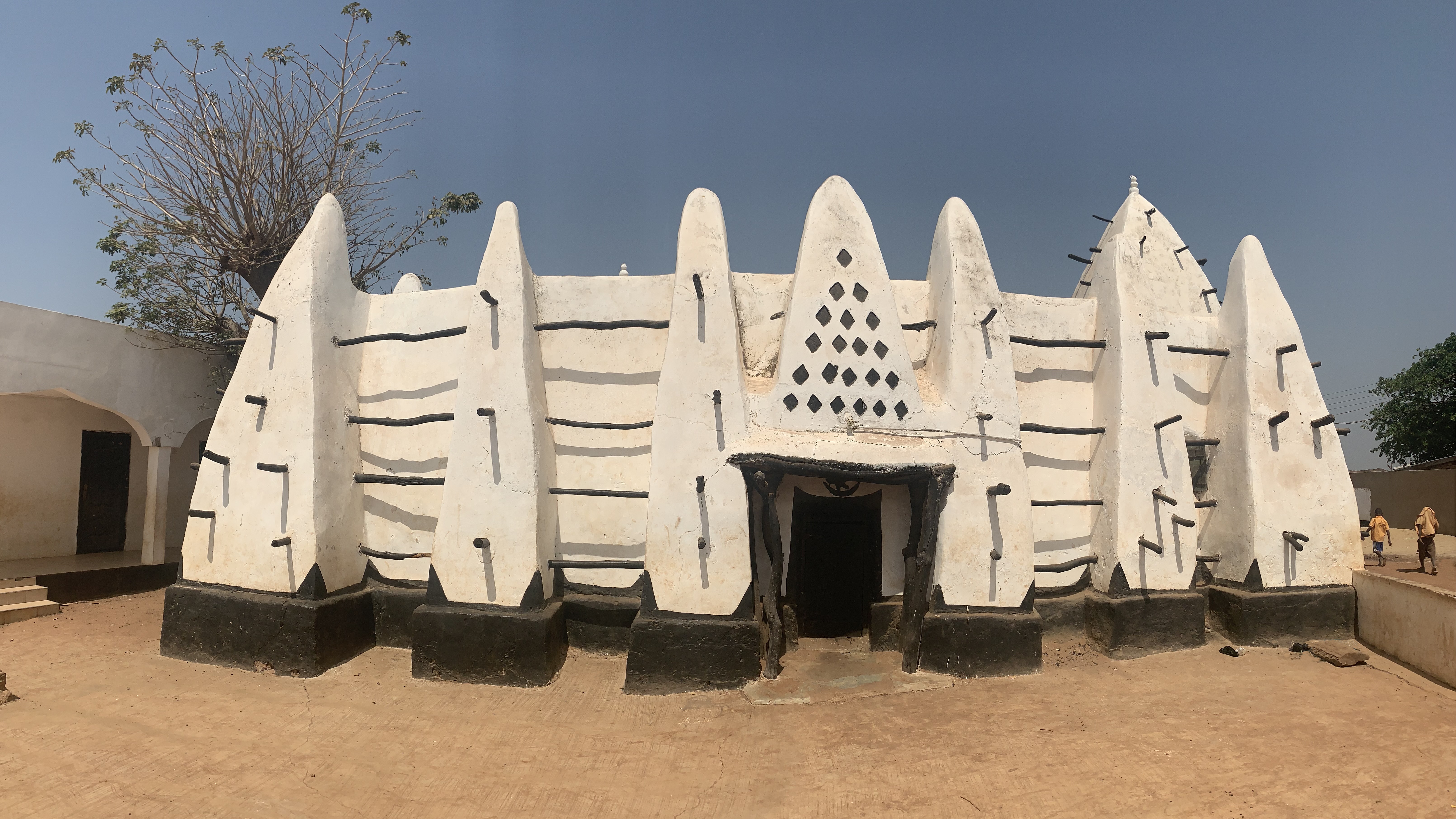
Larabanga Mosque, the Mystic Stone, Mognori Eco Village and other community sites provide opportunities for guided visits, local hospitality and cultural learning.
Bui National Park spans the Savannah and Bono regions and is associated with the Black Volta landscape and hippopotamus habitat. It belongs in the wider regional visitor circuit, rather than being described as a park adjoining the estate.
Proposed hospitality, interpretation centres, artisan markets and attractions would be developed on appropriately approved land, with local participation. Protected areas, sacred sites and wildlife corridors remain distinct from the project’s land allocation.
Sources: Ghana Tourism Authority; Forestry Commission: Bui National Park; Middle Belt Development Authority: Bono Region.
Ghana Tourism Authority lists the Savannah Region at approximately 34,790 square kilometres and describes it as Ghana’s largest administrative region. Administrative boundaries and Gonja customary territory are not interchangeable. This profile therefore makes no unsupported claim that Gonja is the largest tribal land region in all of West Africa.
Its strongest story needs no unverified superlative: a living kingdom, enduring traditions, a broad savannah landscape and communities with a place in their own development future.