
Zion Trust Damongo Estates
Diaspora land participation, residential development and agricultural partnerships.
Explore this program
SAVANNAH DEVELOPMENT DIVISION · GLOBAL EXCHANGE R&E CORPORATION
The Trust office leads the operations and management of the Savannah Development division. All Zion Trust development projects fall under this office’s management, including the estates, residential and agricultural programs and associated civic, hospitality and community-development projects.
Development applications are received for Trust and development-committee review. Members are welcome to express interest in development committees and board-of-directors selections.
Trust office and participation Temporary contact: earthmanherbals@gmail.com
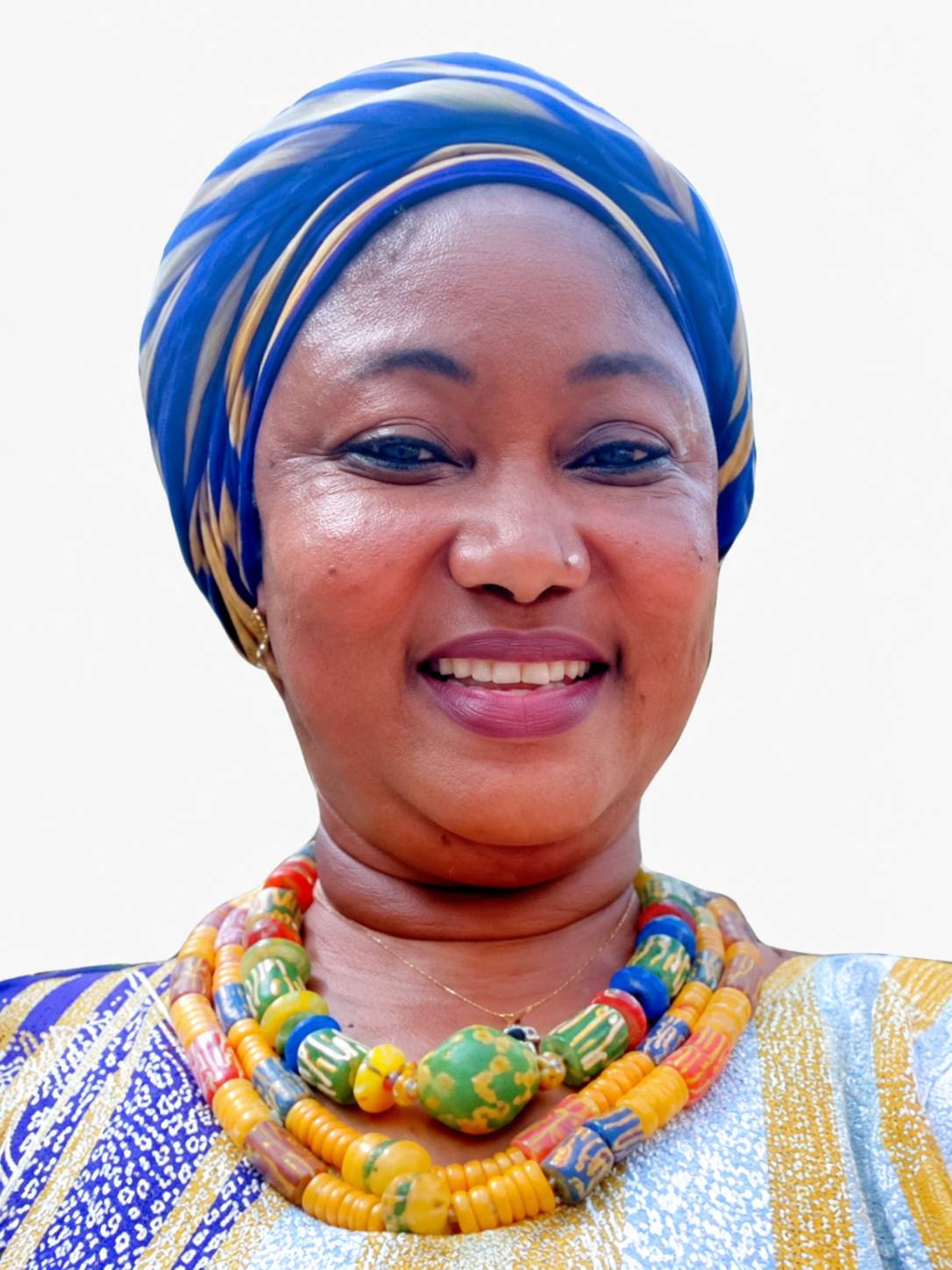
A welcome from our Administrative Governess
As Queen Mother and Administrative Governess of the Royal Savannah Diaspora Association, I warmly welcome our members, diaspora families, and all interested participants.
We invite you to join us in building opportunities through community development, agriculture, enterprise, and cultural connection. Together, we can honour our heritage and help create a prosperous future for Damango and the Savannah Region.
We welcome your participation, ideas, and partnership.
Queen Mother Rama Wayo — Sheri Wurche
Join the Royal Savannah community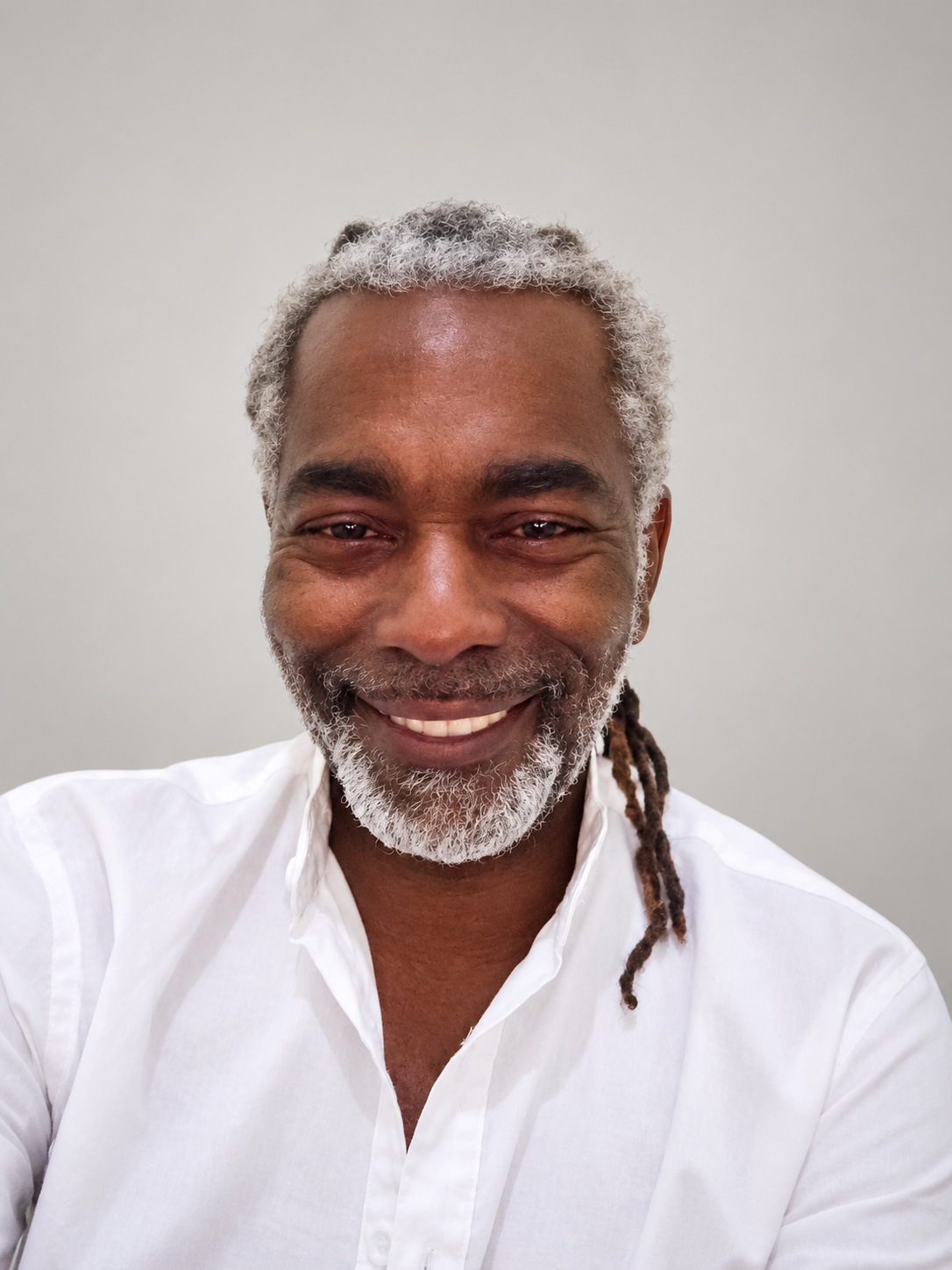
A welcome and vision from our Chairman
Paul Hay serves as Chairman, Project Director and Program Developer of the Savannah Development Group, bringing his leadership of Global Exchange R&E Corporation to project planning, program development, partnerships and international coordination.
Akwaaba. Welcome to Damango City, Savannah Region, Zion Trust Estates, Ghana.
Our vision is to bring diaspora families, local communities, growers, entrepreneurs and development partners together to create practical opportunities rooted in our heritage and shared future.
We begin with One Person, One Acre agricultural development—connecting participation with productive land use, local employment and the development of sustainable livelihoods. From this foundation, our wider vision brings together residential, enterprise and community-development opportunities through carefully planned phases.
I welcome your ideas, skills and partnership. Together with the Queen Mother and the Royal Savannah Diaspora Association, we invite you to help shape a practical, funded program with accountable project delivery and lasting community benefit.
Paul Augustus Hay
Chairman, Project Director and Program Developer
Savannah Development Group
Our first project · Agricultural development
Begin your exploration of Royal Savannah development opportunities with our priority agricultural project. One Person, One Acre connects diaspora members, community growers, sponsors and prospective investment partners with proposed agricultural development in Damango and the Savannah Region.
Explore individual-acre participation or group blocks, seasonal crops and long-term orchards, alongside grower, processor and offtake partnerships. Participation and investment terms are reviewed through the Trust and documented for each approved project.
Explore agricultural participation Request agricultural investment information
Project-specific agreements and approvals apply. Investment returns are not guaranteed.
Residential estates and apartmentsPlots and land developmentCivic Center developmentHospitality and Crown Palace PlazaDevelopment partnerships
Construction estimate C = measured gross floor area (m²) × applicable Accra benchmark (USD/m²). Resale construction component = C × 1.50. The 50% increase includes the resale markup; it is not a separate inflation reserve. This replaces the previous construction uplift and revenue-margin formula. No additional automatic markup or contingency is stacked on this calculation.
Measure each apartment's practical net area and allocate walls, circulation, cores and common building areas once to determine gross construction area. Existing concept sizes and 70% net-to-gross efficiency are illustrative until measured by the design team; they do not establish code compliance.
Land, site preparation, infrastructure, fixtures/appliances and fitout excluded from the benchmark, professional fees, taxes and financing remain separate, reconciled cost lines. Preliminary combined amount = 1.50 × construction cost + allocated land + other separately established costs. No second markup is assumed on those separate lines. Final sale offers remain pending complete costs and approved layouts.
Owner's latest land planning assumptions: Savannah / Zion Trust Estates US$20,000/acre; in-town Civic Center US$30,000/acre (17 acres = US$510,000); other development land US$25,000/acre. These are owner allowances, not verified acquisition costs or public land offers.
Source: AECOM Africa Property & Construction Cost Guide 2025/26, Accra, page 75; cost date 1 July 2025, FX date 1 May 2025. These are dated published benchmarks, not 2026 Damongo supplier quotations. A 50% cost markup equals 33.33% gross margin on the construction component before excluded costs.
Current formula, apartment calculations and project schedules. All pending construction proposals use this policy; prior financial schedules are superseded.
Purpose of the registration contribution: The one-time US$10 registration payment contributes toward system hosting, maintenance and administrative support.
Browse freely. A one-time US$10 registration and participation fee must be paid and confirmed before joining or submitting participation applications. Project-specific costs are separate.
GLOBAL EXCHANGE R&E CORPORATION · GHANA
Savannah Region · Aviation · Infrastructure · Community Agriculture
Diaspora land applicationProposed plan updated to include agricultural supplier contracts and the “One Person, One Acre” community production program.
Individual membership adds $100 once: $4,870 including membership. Ten acres: $46,200 core + $1,500 rent + $500 group membership = $48,200. Preparation already includes its clearing/plowing allowance; the same machine cost or worker wage is not added again.
40% down on core $4,620 = $1,848, followed by twelve $231 payments. If annual rent is included in the funded value: $1,908 down and twelve $238.50 payments. Membership is separate. Fruit-tree extras and other agreed inputs change the documented total and installment amounts.
Additional fruit trees are separately costed only beyond the inputs already covered by the $1,000 planting budget. At the earlier provisional $5–10/seedling, 50 extra seedlings add $250–500; 100 add $500–1,000. Crop spacing and supplier quotations govern quantities and prices. Irrigation, fertilizer, additional materials, storage, special equipment and future crop-cycle input replenishment remain separately assessed.
These are the sponsor's revised budget inputs. The 20% annual net-return objective is conditional on realized earnings: $924 on $4,620 core or $954 on $4,770 rent-inclusive funding, not a guarantee. Six-month crop cash may offset future payments or be reinvested after reconciliation; fruit trees have their own maturation schedules.
Apply for agricultural development participation Trust management and committee participationFor development applications, Trust management and committee participation inquiries: earthmanherbals@gmail.com.
Online applications are recorded for review by the Royal Savannah and Diaspora Community Development Trust. Trust management and participation
Royal Savannah and Diaspora Community Development Trust is the designated management and development-review body for Zion Trust Damongo Estates. Individual development, residential, land-use and investment applications are received through the project forms for Trust and development-committee review.
Members are invited to express interest in joining development committees and participating in board-of-directors selections. Committee membership and board appointments follow a documented review and selection process.
Meet the Trust · Apply for committee or board participationBuyers of Savannah apartments, condominiums and housing plots receive an additional five-acre agricultural development land allocation through an accompanying lease agreement. Use the allocation to participate in agricultural investment, development and related industry projects, with opportunities to develop income-producing activities.
Lease rate: US$20 per acre per year · five acres: US$100 annually · initial term: five years. Base land rent totals US$500 over the initial five-year term. The lease is renewable and extendable with the investment, with renewal and extension terms recorded in the agreement.
The agricultural allocation is leased land alongside the residential purchase. The agreement will identify the parcel, land-use rights, commencement date, payment schedule and investment/development arrangements. Cultivation, management, infrastructure and other development costs are separate from the stated land rent. Income depends on the selected project and actual operations; no fixed income is promised.
Enquire with your apartment or condominium application · Explore housing plots · Agricultural development program
Explore a new 15-storey tower option with 204 concept apartments: one-, two- and three-bedroom homes plus four- and five-bedroom executive residences. Select a floor and unit ID, review the site and unit diagrams, and apply for pre-purchase or development investment documentation.
Explore virtual residences and applyAlternative concept for review; no surveyed allocation or reservation is established. This does not replace the existing downtown tower budget without a separate design decision.
Diaspora land participation, residential development and agricultural partnerships.
Explore this program
The separate 17-acre downtown development: civic space, offices, retail, entertainment and a central water garden.
Explore this program
Proposed hospitality and guest-residential program within the Civic Center Square.
Explore this programZion Trust Estates is outside Damongo town, approximately a 15-minute drive away as described by the sponsor. Its current program is a 10,000-acre city and separate 10,000-acre agriculture estate. The proposed Damango Civic Center Square is a different 17-acre rectangular main-street site inside town, with fountain park, mixed-use high-rises, conferences and guest-residential accommodation.
Business plan & online investment / official responsesSeparate 17-acre civic-center site planNew estate lease proposal: USD150 per acre annually. The 100-year development horizon is subject to lawful lease terms; no new grant, project approval or finance commitment is implied.
Explore the Yagbonwura, seven historical Gonja divisions, living traditions, the project-reported sealed Zion Trust diaspora land grant, and the Mole–Larabanga and wider Bui/Bono heritage landscape.
Read the cultural and royal profileCooperating community participants would be employed on one-acre agricultural production plots under agreed farming, supplier and procurement arrangements. The objective is to connect productive employment and community development with local food and herbal supply, processing, distribution and wider industry benefits.
Land planning figure: 31,360 acres — seven miles by seven miles, or 49 square miles. This is the stated gross development area; confirmed cultivable acreage must account for roads, housing, aviation facilities, utilities, community uses and environmental protection. The figure does not establish 31,360 jobs or production-ready plots.
| Plot type | Plots per net acre | Plot area |
|---|---|---|
| Standard homes | 6 | 674.48 m² |
| Townhouses | 8–10; draft baseline 9 | 505.86–404.69 m²; baseline 449.65 m² |
| Estates | 4 | 1,011.71 m² |
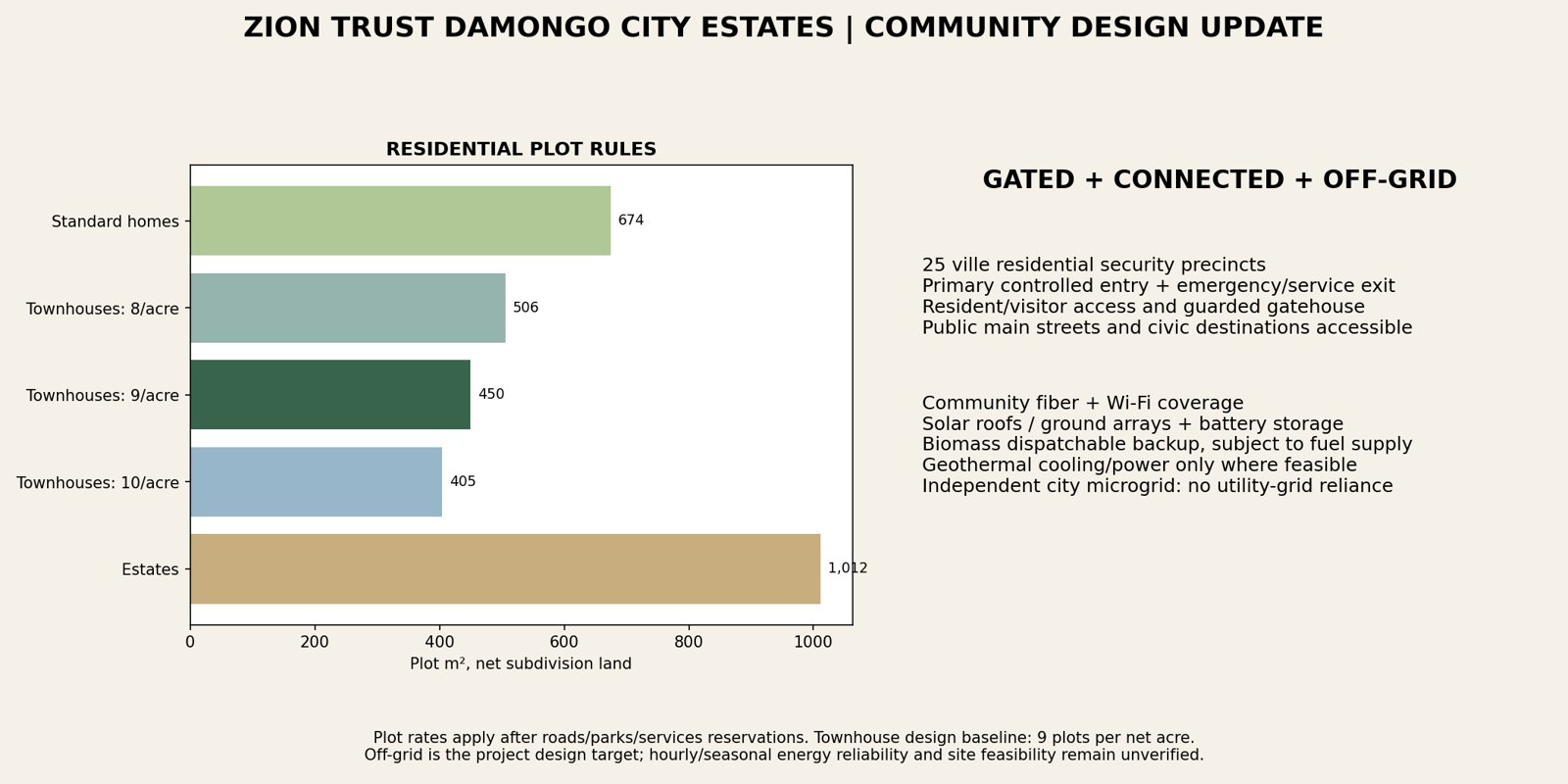
For a ten-acre gross block with six net plot acres, townhouse capacity is 48, 54 or 60 homes at 8, 9 or 10 plots/acre. The existing 36-plot Mississauga schematic is now the standard-home option, not the townhouse option. Use its local-loop and odd/even-numbering approach for the separate townhouse layout; its smaller townhouse parcels and exact drive/parking arrangement still need a drawing. At assumed 160 m² home GFA and earlier $1,800–2,400/m² plus 38% shared allowances, the 54-home townhouse block costs approximately $21.5–28.6M. These analyst allowances exclude land/tax/finance/bulk systems and are not bids. Final adopted unit mix must replace the earlier apartment capacity scenario.
Each of the 25 ville themes has a proposed residential security precinct, with a primary staffed access gate and a separate emergency/service access point. Use gate IDs Bxx-G01 and Bxx-G02, resident credentials, visitor registration, vehicle queuing, pedestrian access, gatehouse/security patrols and communications. Reserve about 0.5 acre per ville for access/security facilities inside its existing road/service allowances (12.5 acres citywide), subject to final layout; this is not additional plot land. All dwelling clusters, including apartment courts, townhouse compounds and estates, receive controlled entry design. New Kingston's cultural districts may host smaller residential precincts around public facilities.
Public main streets, lake promenade, schools, parks, shopping and regional civic facilities remain publicly accessible through their own entrances; residential security gates do not close the public road network. Emergency responders need independent access, manual override and backup power. Actual boundary fencing, gate sites, staffing and operating costs require the adopted residential site layout. Security arrangements are a design provision, not a guarantee of crime prevention.
The design brief is a fully off-grid city energy system with no dependence on utility-grid imports. Plan coordinated borough microgrids with solar roofs, ground-mounted solar, grid-forming battery storage, and dispatchable biomass backup. Geothermal is an option only after resource/ground investigations: shallow ground-source cooling is distinct from electricity-generating geothermal, and neither receives a guaranteed electrical output in this model.
Illustrative energy test for the previous 136,224-home core scenario: assume 10 kWh/home/day plus 25% nonresidential allowance, giving 1.703 GWh/day and 71.0 MW average. The earlier 340.6 MW value is a diversified peak assumption, not average energy use. Candidate system: 600 MWp solar (200 rooftop + 400 ground), 1,300 MWh battery nameplate with approximately 1,040 MWh usable at 80% depth of discharge and about 400 MW battery power, plus 40 MW biomass. At an assumed 4 kWh/kWp/day solar yield, output is 2.4 GWh/day before an assumed 20% downstream loss/reserve factor, or 1.92 GWh/day after it. The assumed solar yield is not a measured Damongo forecast.
This test does not establish year-round off-grid reliability: storage provides only about 14.7 average-load hours, and 40 MW biomass does not support the whole assumed 340.6 MW peak or full average load alone. Hourly/seasonal solar, demand, outages, battery cycling, fuel sustainability and extended low-sun periods must determine more storage/generation, load management and critical-load service. Airport, fuel-storage processing, industrial loads and future expansion are additional demand studies. Biomass requires verified feedstock, emissions controls, water and logistics.
Earmark 2,000 acres for candidate 400 MWp ground solar at an assumed 5 acres/MWp, plus 100 acres for energy hubs, from the already reserved 5,000-acre expansion window, leaving 2,900 expansion acres for other needs. Rooftop solar does not add ground acreage. Actual solar row spacing, airport glare/height constraints, fuel separation and utility access must determine siting; these energy reservations are within the estate, not additional land purchases.
Gross generation/storage allowance: $854–1,390M base, or $1,093–1,779M including 8% engineering and 20% contingency. Rates are analyst-selected placeholders: solar $0.7–1.1M/MWp, batteries $0.18–0.30M/MWh, biomass $3–5M/MW, controls/integration $80–140M. No current supplier quote is implied. Distribution/substations remain in the separate infrastructure program; reconcile overlapping controls, fees and on-site services before combining. Excludes land, taxes, finance, geothermal, fuel and ongoing operations, battery replacements and abnormal works. This supersedes any earlier assumption that generation could rely on grid reinforcement.
Provide fiber backbone and wireless coverage planning for all residential precincts, public destinations, gates and emergency services, powered by the off-grid network. The earlier 500 Wi-Fi nodes are a starting allowance, not evidence of complete coverage. Survey indoor/outdoor signal levels, backhaul availability, subscriber concurrency and resilience; add access points and capacity as needed. Separate resident/guest networks from security and emergency operational systems. Internet connectivity still requires external communications backhaul; electrical independence does not mean isolation from the internet.
General technical references: DOE microgrid systems and Global Solar Atlas methodology. These support the study approach, not the assumed cost rates or a certified site design.
Standard residential land is subdivided into six plots per net plot acre (674.48 m² each); estate land into four plots per net plot acre (1,011.71 m² each). Roads, parks, utility reserves and setbacks are allocated before applying this rate. Gross city acreage is not treated as entirely saleable land.
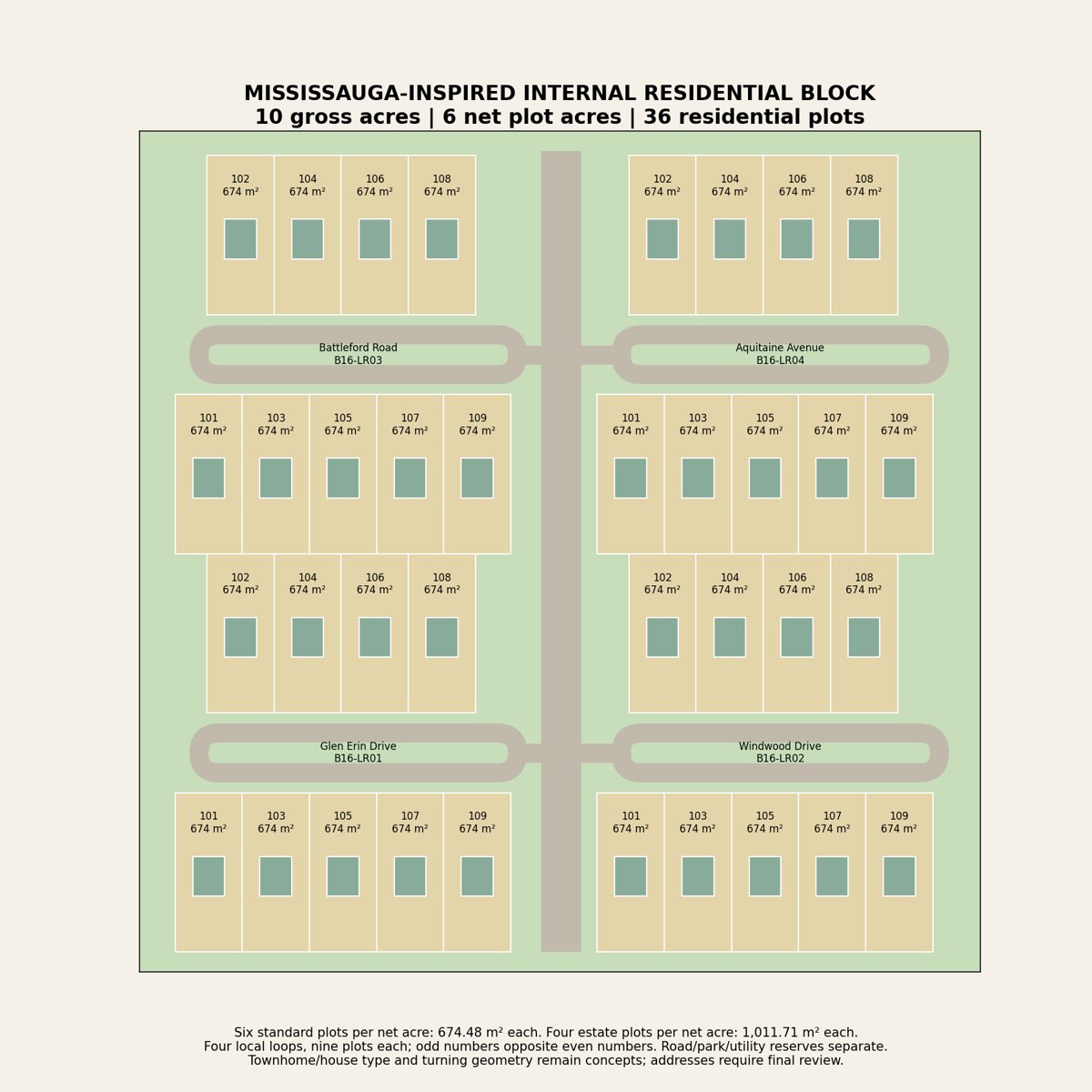
The revised ten-acre internal block provides six net acres of residential plots and four acres for circulation, green space and services: 36 plots rather than the previous 64 smaller plots. Land budget: 24,281.14 m² plots, 9,000 m² roads/access, 5,000 m² green space and 2,187.42 m² utilities/flexible space. Each plot accommodates a concept 160 m² two-storey home; plot area is not house floor area.
Four loops retain Mississauga-inspired Glen Erin Drive, Windwood Drive, Battleford Road and Aquitaine Avenue, nine plots per loop. Odd addresses 101–109 oppose even addresses 102–108. Each address includes borough, block and unique street ID. Example: 101 Glen Erin Drive, Block D / B16-LR01, Canadaville / Toronto, Zion Trust Damongo City Estates. These are proposed Damongo numbers, not copied Mississauga civic addresses. Local-loop design can be adapted across boroughs with each borough's cultural names; main-street eight-storey commercial frontage is retained separately.
New ten-acre house-block cost: $14.3–19.1M for 36 homes at 160 m² each, using the earlier assumed $1,800–2,400/m² plus 38% local-services/fees/contingency uplift. This is a concept allowance, not a quote. Land, tax, finance and bulk systems excluded. It replaces the earlier 64-home/$25.4–33.9M example. Compared with a 288-home internal apartment block, this option reduces that block's capacity by 252 homes; population, shopping, utilities and total cost must be recalculated for the adopted mix.
Waterfront estate plots now follow four per acre: the existing 20-estate-home option requires five net acres of plots (20,234.28 m²), replacing its former 500 m² plot sizes. Within its ten-acre gross block, retain 1,800 m² tower footprint, 6,000 m² access, 5,000 m² park/promenade, 5,000 m² parking and 2,434.28 m² flexible/utility space; house footprints are within estate plots. Its 196 tower apartments plus 20 estate homes remain the capacity comparison, with 220 m² estate home GFA unchanged. The reduced public-space allowance and actual lot/road fit require waterfront redesign; the old small-estate-plot drawing is superseded.
Mississauga reference source: City Glen Erin road-study map. Original Damongo schematic, pending survey, architecture, drainage, emergency-access and final naming/numbering review.
The 10,000-acre city layout is now the first-phase core rather than a fixed development ceiling. Earmark up to 5,000 additional acres from the wider 31,360-acre estate for staged expansion, allowing treatment plants, utility corridors, airport/approach needs, community facilities and future housing/industry to gain land as feasibility and growth require. The 2,000, 4,000 and 5,000-acre scenarios are planning options, not compulsory buildout or a final upper limit.
| Additional city land | City envelope | Separate external fuel reserve | Other estate land |
|---|---|---|---|
| None: current core | 10,000 acres | 500 acres | 20,860 acres |
| 2,000 acres | 12,000 acres | 500 acres | 18,860 acres |
| 4,000 acres | 14,000 acres | 500 acres | 16,860 acres |
| 5,000 acres | 15,000 acres | 500 acres | 15,860 acres |
Current bookkeeping reserves 5,000 acres for potential expansion, separate from the 10,000-acre core and separate external 500-acre fuel reserve, leaving 15,860 acres unassigned to those reservations. If the city adopts the full 15,000-acre envelope, that same land moves into the city; it is not counted twice. No expansion boundary or extra residential count is drawn yet.
Increase wastewater/solid-waste land beyond initial 30/10-acre allowances when process sizing requires it; reserve additional industrial separation and drainage space. Airport runway, approach and safety land can likewise be enlarged following feasibility. Detailed parcel boundaries and the compatible relationship between airport, fuel storage, lake and neighborhoods govern the expansion layout. The current approximately 490,000-person scenario and infrastructure cost range cover the original 10,000-acre core only. Added housing, utility capacity and infrastructure cost must be recalculated for each expansion phase rather than assumed proportional to acreage.
This section supersedes earlier wording that the city must remain at exactly 10,000 acres. The core allocation tables still reconcile to 10,000 acres; their “no additional acreage” statements refer to those first-phase allocations. Expansion is authorized for concept planning but remains subject to surveyed land, tenure, siting and design requirements.
Reserve 30 acres for wastewater treatment/sludge handling and 10 acres for solid-waste transfer, sorting and recycling within New Kingston's existing 200-acre service/access allowance. The remaining allowance is 20 acres for water/power/telecom compounds, 120 acres for district roads/access and 20 acres for drainage, protective buffers and expansion. These are program allowances, not verified facility footprints; the city total remains 10,000 acres. Additional land may be required after process sizing.
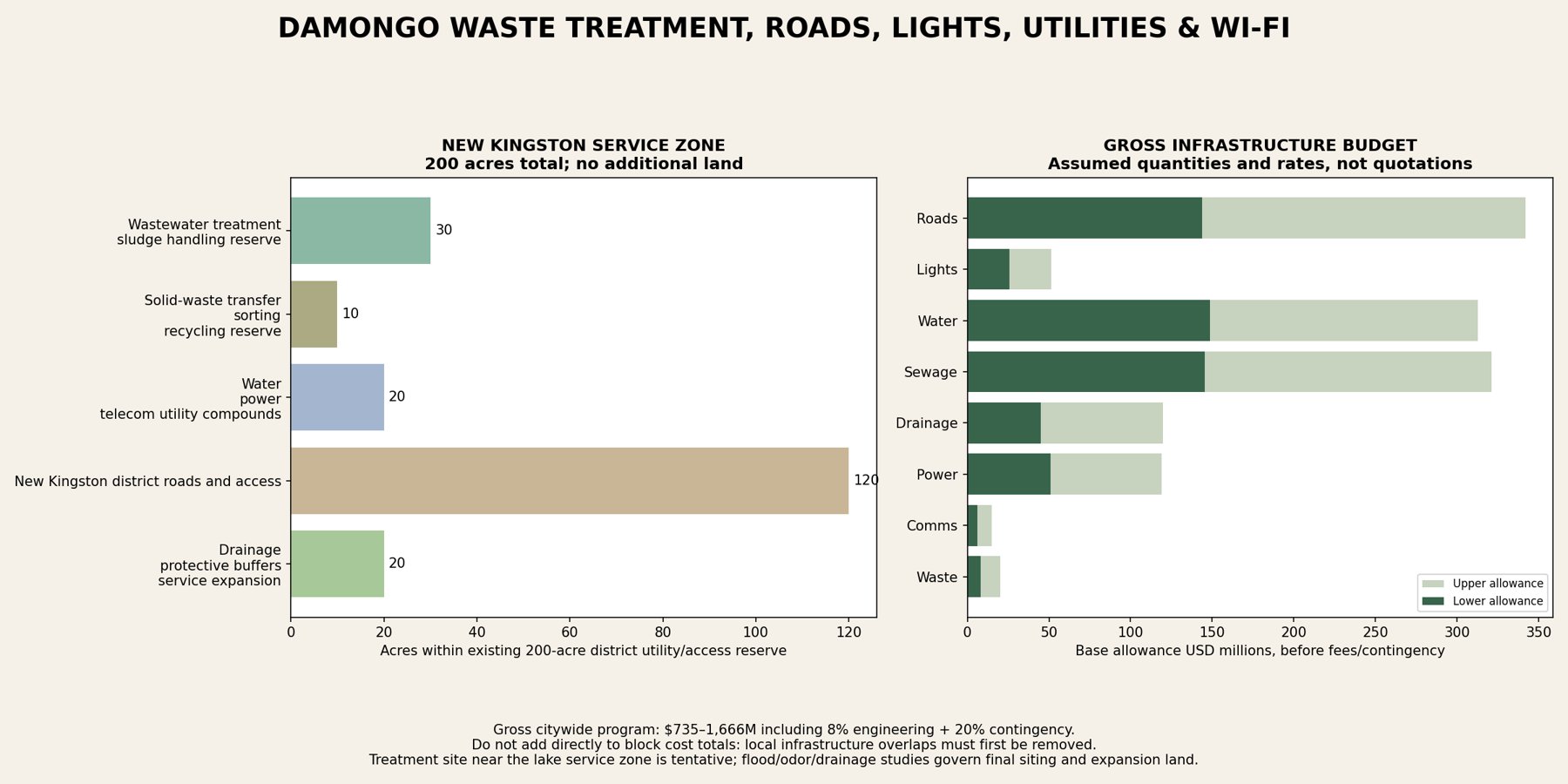
Consider a location in the lake-adjacent service zone, with physical separation from recreation and waterfront homes. Lake proximity is not a siting approval: use topography, gravity sewer routing, flood levels, prevailing wind, odors, groundwater and water-quality protection to select the site. No raw sewage, waste leachate or untreated runoff is proposed to enter the lake. Reuse treated water for appropriate nonpotable purposes only after treatment and quality assessment; an outfall route is not selected. Solid-waste land is not a landfill allowance; hazardous, clinical and fuel-related wastes need separate handling arrangements.
Protect treatment assets from flooding and provide backup power, sludge containment, separate stormwater/sanitary systems and secure service access. Technical reference: EPA flood-resilience guidance, used as general engineering context, not Ghana permitting criteria.
| System | Draft quantity | Base range |
|---|---|---|
| Arterial roads | 60.0 km | $60.0–150.0M |
| Local roads | 240.0 km | $84.0–192.0M |
| Street lighting | 10,286.0 fixtures | $25.7–51.4M |
| Water distribution | 300.0 km | $45.0–105.0M |
| Water treatment / pumping / storage | 103.9 ML/day | $103.9–207.7M |
| Sanitary sewer / pumping | 300.0 km | $75.0–180.0M |
| Wastewater treatment / sludge systems | 70.6 ML/day | $70.6–141.2M |
| Stormwater drainage | 300.0 km | $45.0–120.0M |
| Power distribution / substations | 340.6 MW | $51.1–119.2M |
| Fiber backbone | 300.0 km | $4.5–10.5M |
| Public Wi-Fi nodes | 500.0 nodes | $0.5–1.2M |
| Network core / communications systems | 1.0 allowance | $1.0–3.0M |
| Waste transfer / sorting / recycling facility | 1.0 allowance | $8.0–20.0M |
| Base subtotal | $574.3–1,301.3M | |
| With 8% engineering + 20% contingency, both on base | $735.1–1,665.7M |
All quantities and unit rates in the accompanying CSV are analyst-selected planning assumptions, not observed Ghana prices, contractor quotations or measured bills of quantities. Road lengths test 60 km arterial and 240 km local; actual network length and widths require the revised airport/tank-farm master plan. Lighting counts assume two-sided arterial and one-sided local installation at roughly 35 m spacing, not a photometric design. Civil drawings must reconcile right-of-way and existing block service land before final costs.
Water 103.9 ML/day, sewage 70.6 ML/day and electrical load 340.6 MW refer to the earlier approximately 490,000-person full-development scenario. They are average planning loads, not final peak/process capacities. Wastewater cost allowance does not establish that the 30-acre reserve can accommodate that capacity. A staged or decentralized treatment strategy and additional land may be needed. Water-source availability, peak factors and industrial/airport/fuel loads need separate studies. Power costs exclude new generation and upstream grid reinforcement.
Communications provision: fiber along utility corridors, redundant uplinks where available, approximately 500 initial public Wi-Fi nodes, network core, regional service connectivity and separate operational links for emergency services. Household broadband and public Wi-Fi capacity require coverage, spectrum and provider plans. Airtime/backhaul subscriptions, network operations and cybersecurity operating costs are excluded from capital allowances.
This is a gross system-level cost plan. Previous apartment-block budgets already include a 15% local site/services allowance: roads, drains, utilities and lighting must be reconciled against those allowances before creating a consolidated budget. The infrastructure range is not simply added to the earlier block totals. Excludes land, taxes, finance, escalation, operating costs, major abnormal ground/flood works, lake excavation/dams and airport/tank-farm-specific infrastructure. Waste facility equipment is included as a broad allowance; technology and fleet schedules remain unpriced.
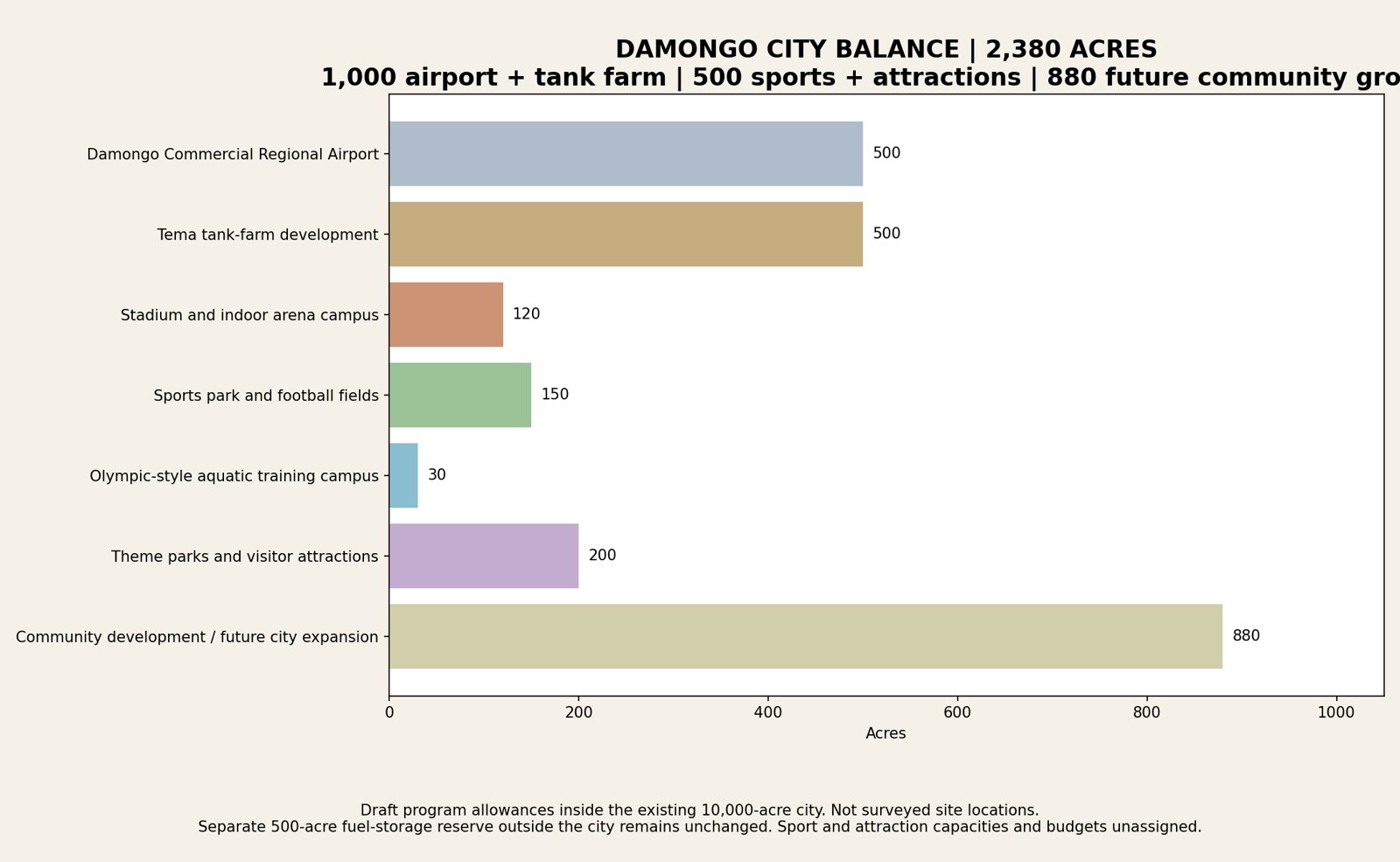
The reconciled city balance is 2,380 acres. The latest “2,388” reference is treated as a wording correction, not an eight-acre increase. Confirmed allocation: 500 acres for the Damongo Commercial Regional Airport and 500 acres for the Tema tank-farm development, totaling 1,000 acres inside the city balance. The separate 500-acre fuel-storage reserve outside the city remains recorded.
| Draft allocation | Acres |
|---|---|
| Damongo Commercial Regional Airport | 500 |
| Tema tank-farm development | 500 |
| Stadium and indoor arena campus | 120 |
| Sports park and football fields | 150 |
| Olympic-style aquatic training campus | 30 |
| Theme parks and visitor attractions | 200 |
| Community development / future city expansion | 880 |
| Total city balance | 2,380 |
The 1,000-acre airport/tank-farm split is confirmed; the 1,380-acre remainder uses preliminary design allowances: 120 acres for a stadium/indoor arena campus, 150 acres for sports park and football fields, 30 acres for an Olympic-style pool training campus, 200 acres for theme parks/attractions and 880 acres for future community projects and city expansion. These draft suballocations can be refined without changing the city total.
Stadium/arena provision includes event access, athlete areas, parking/loading and ancillary public facilities; seating capacity is not set. Sports park includes football training and match fields, recreation and accessible walking routes. The aquatic campus proposes a 50 m training pool plus warm-up/teaching pools, changing, coaching, plant and visitor access; this is a concept provision, with no claim of Olympic certification. Theme-park and attraction plots can be developed through proposed community/partner projects, subject to planning, operating arrangements and demand.
The 880-acre future reserve is available for community-led development and phased city expansion based on growth. Individual, group and organizational participation can proceed through the existing land-use application and project review process; no plot title, sale or tenure grant is made by this plan. Future changes must reconcile roads, utilities and environmental capacity with the original 10,000 acres.
The earlier designation of the entire 2,380-acre balance jointly for the airport and tank farm is superseded by this schedule. The earlier full-city housing estimate does not include additional homes from the future expansion reserve. Current block grid is a planning placeholder: airport runway/approach geometry, contiguous site assembly, fuel buffers and lake relationships require master-plan redesign. The 500-acre airport allowance is a reservation, not evidence that a particular runway/aircraft capacity fits. Sports, airport, tank-farm and attraction capital/operating budgets are excluded from the previous apartment/mall cost ranges.
The retained estate planning area is 31,360 acres (seven miles by seven miles). The latest reference to “35,000-plus acres” is not substituted without a revised survey or land schedule.
| Estate allocation | Acres |
|---|---|
| City development concept | 10,000 |
| Separate Tema–Damongo fuel-storage development reserve | 500 |
| Remaining estate: agriculture, future industrial and airport-related facilities and other proposed developments | 20,860 |
| Estate total | 31,360 |
Inside the 10,000-acre city, 2,380 acres are now allocated as 500 acres for the Tema tank farm, 500 acres for Damongo Commercial Regional Airport, 500 acres for sports/attractions, and 880 acres for future community development and city expansion. The physical sites, runway orientation, approach areas and safety buffers remain unassigned; the city grid requires redesign for these uses. This is a component of the city acreage, not additional estate land. Existing housing assumptions, the New Kingston lake district, service stations, emergency facilities, education, parks and religious-site reservations remain allocated. Revised zoning must determine compatible activities and buffers.
The separate 500-acre fuel-storage reserve is drawn from the 21,360 acres previously outside the city concept, leaving 20,860 acres outside both. It supports the proposed Tema–Damongo fuel-storage project. Site boundary, transport connections, storage capacity and construction budget remain to be defined; no airport, tank capacity or additional project acreage is implied. The Damongo Commercial Regional Airport is now proposed within the combined 2,380-acre city reserve. Additional estate land for approach corridors, expansion or associated facilities would require separate allocation. The 500-acre fuel-storage reserve outside the city remains separate; it is not deducted again from the 2,380 acres. No airport or tank-farm layout or operating capacity is established by this land reservation.
Estate and city figures are concept-planning allocations pending survey and land agreements. Agricultural and industrial allocations require appropriate separation from residential, public water, medical and education uses. Fuel storage and any airport development need separate siting, engineering and approvals. These future projects are outside the earlier residential/mall cost estimates.
Additional reservations within the 10,000-acre city: 100 acres for five school campuses beside 100 acres of neighborhood city parks, a 40-acre institutional/vocational education campus, and 50 acres of religious/community plots. Religious sites are open to individual applicants and organizations for proposed acquisition or long-term lease, subject to verified land rights and agreements.
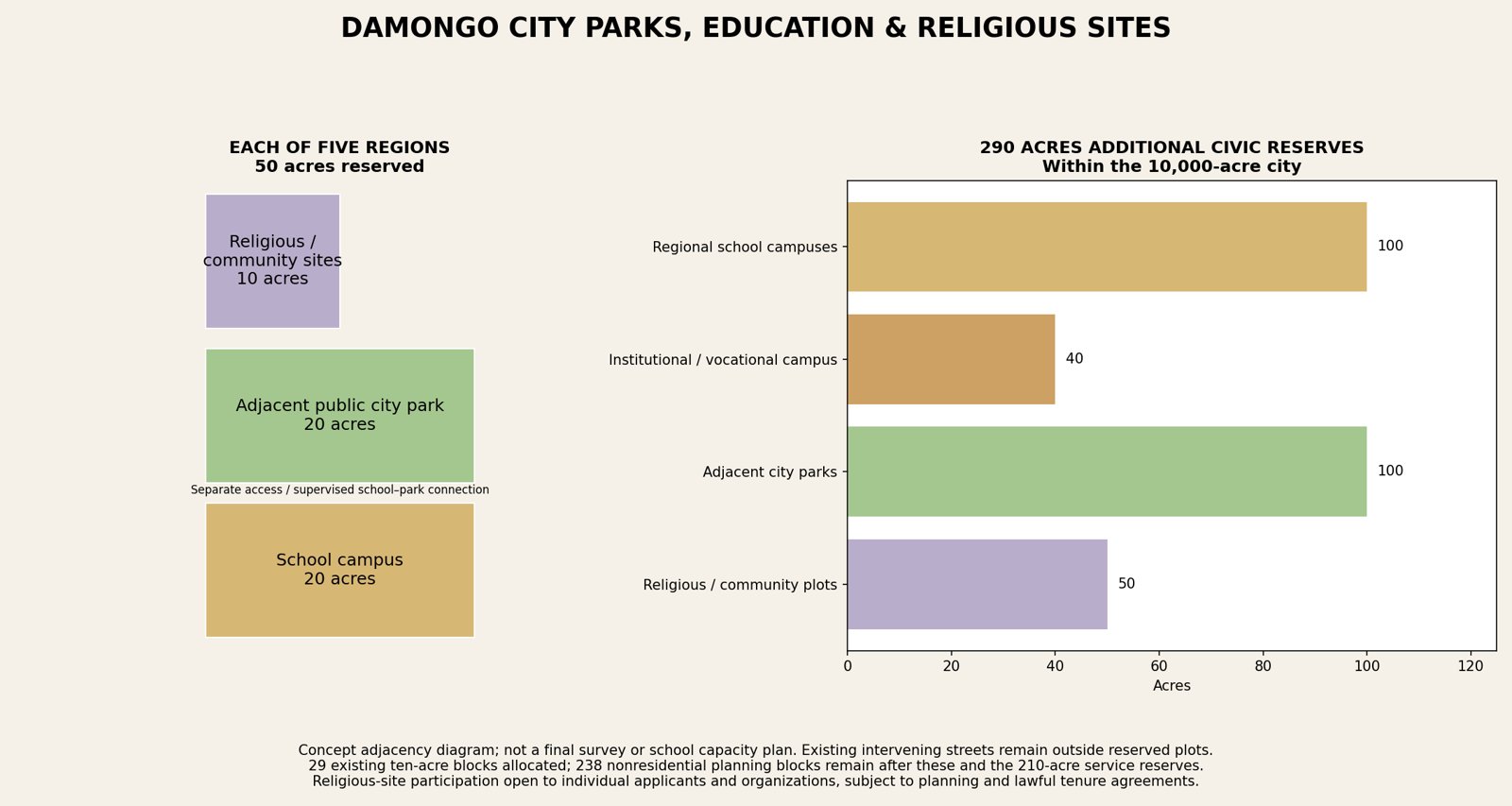
The combined service and civic reservations total 500 acres, leaving 2,380 acres of the earlier nonresidential allocation for future uses. No acreage is added to the city total.
See the park, education and religious-site plan · Apply for land use or participation
210 acres are reserved within the existing nonresidential allocation: five 40-acre regional service campuses plus a 10-acre police/fire/ambulance coordination headquarters. Each campus reserves sites for two fuel stations with garages and convenience stores, an automotive service area, a supermarket/medical plaza, a police base, a fire/ambulance base, and shared access/buffers.
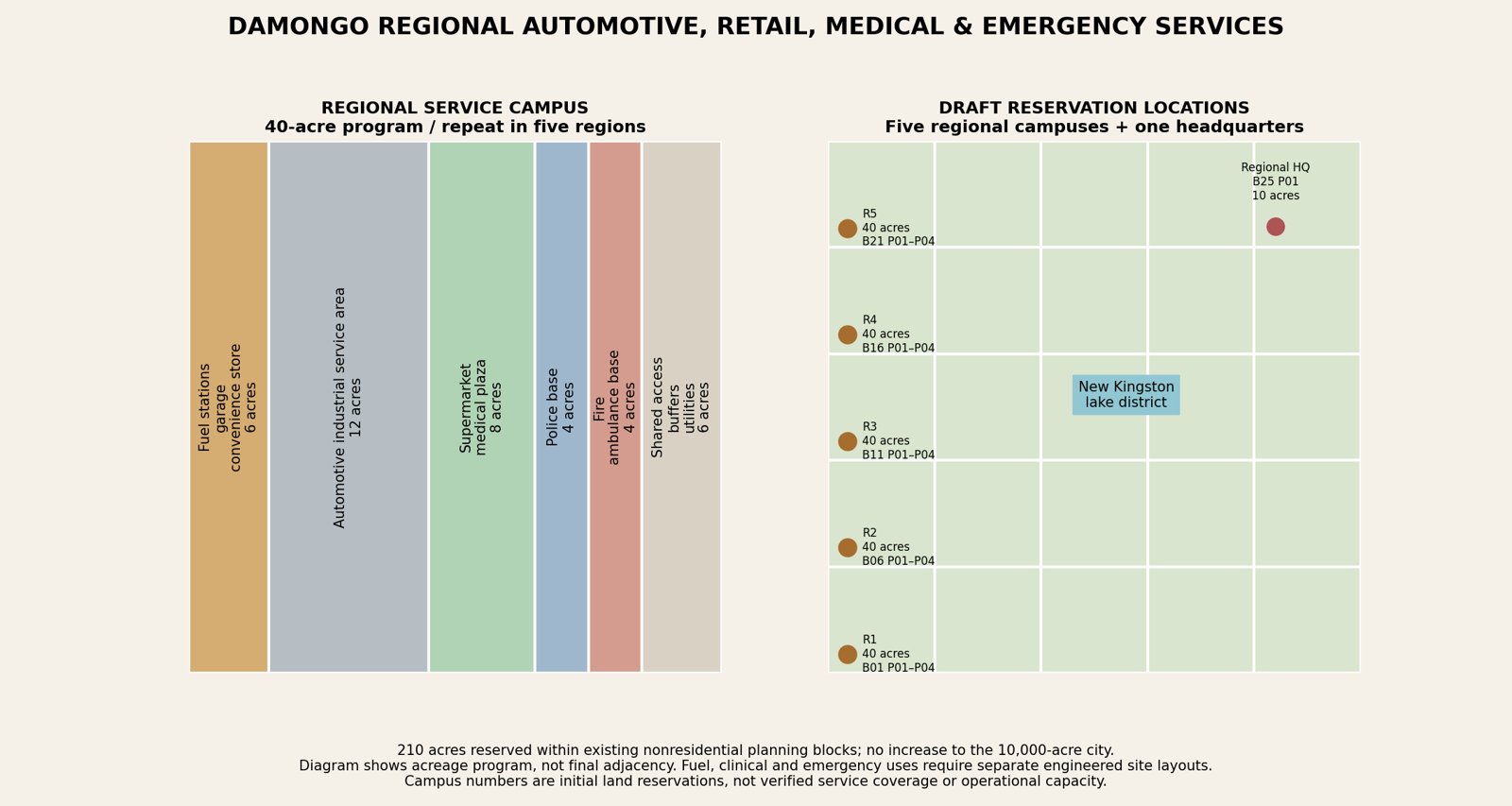
View allocations and the service plan. These are draft land reservations; operating capacity and response coverage require separate studies. Service-facility construction and equipment are outside the earlier apartment and mall cost totals.
Twenty noncentral boroughs plus five New Kingston areas: a 19,200-home low-rise test yields US$1.126B in quantified land, servicing and house allowances; US$1.2934B including a 15% contingency on servicing and homes. Garages and major civic, industrial, lake, energy and high-rise facilities are separately budgeted. This is an alternative to the earlier apartment-capacity scenario.
View phased borough, house and ten-acre block costing →Start with numbered residential plots and proposed addresses, then explore mixed-use apartment and penthouse options.
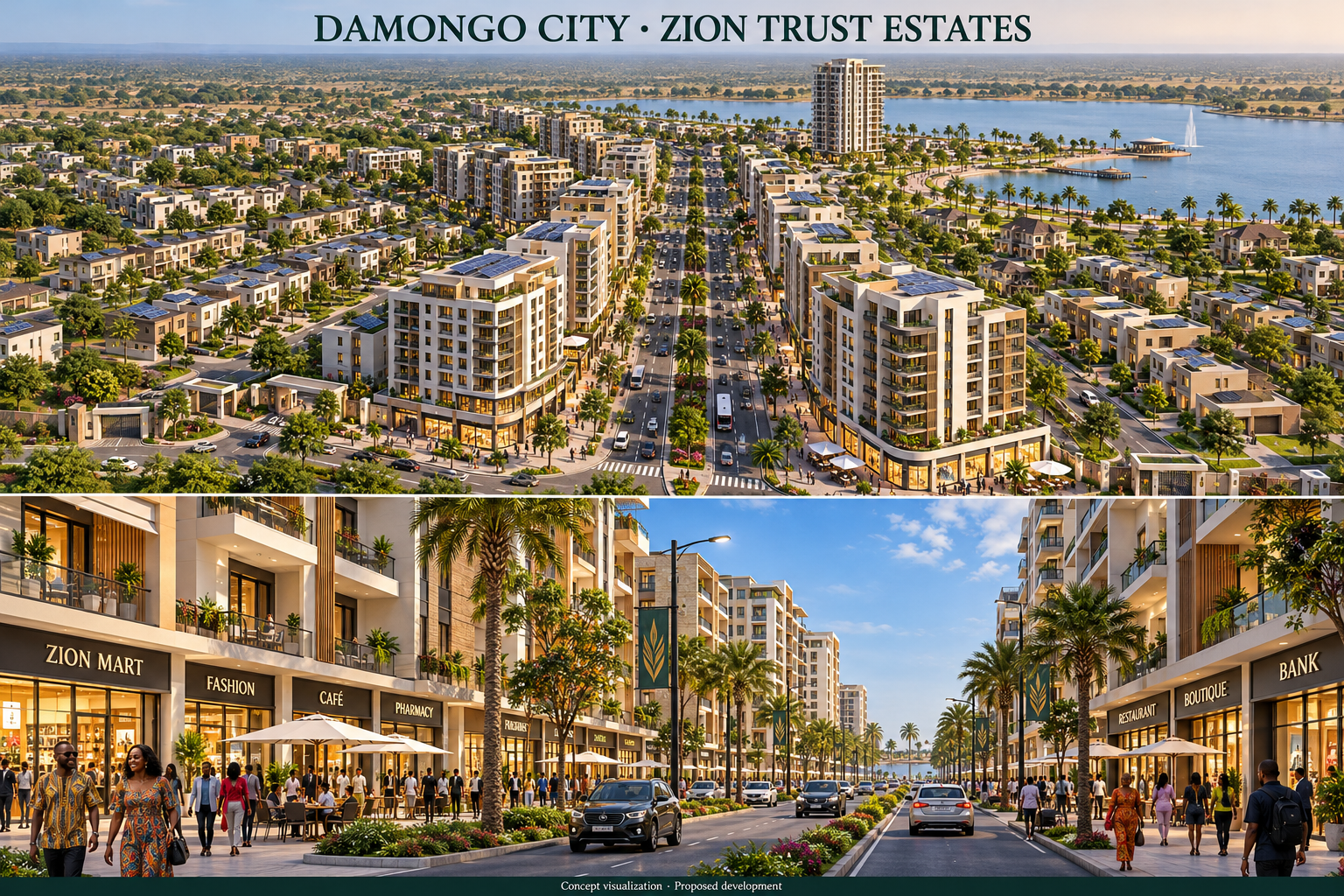
Concept visualization of intended development, not existing construction. The separate ten-acre capacity study contains 346 apartments plus 24 houses after penthouse combinations.
View plot addresses, city block layout and apartment purchase estimates →Main-street commercial frontage on both sides, with eight-storey buildings containing shops on the ground floor and apartments above. Six-storey internal apartment blocks extend inward; New Kingston waterfront sites mix 15-storey towers, ground-floor commercial units and estate plots.
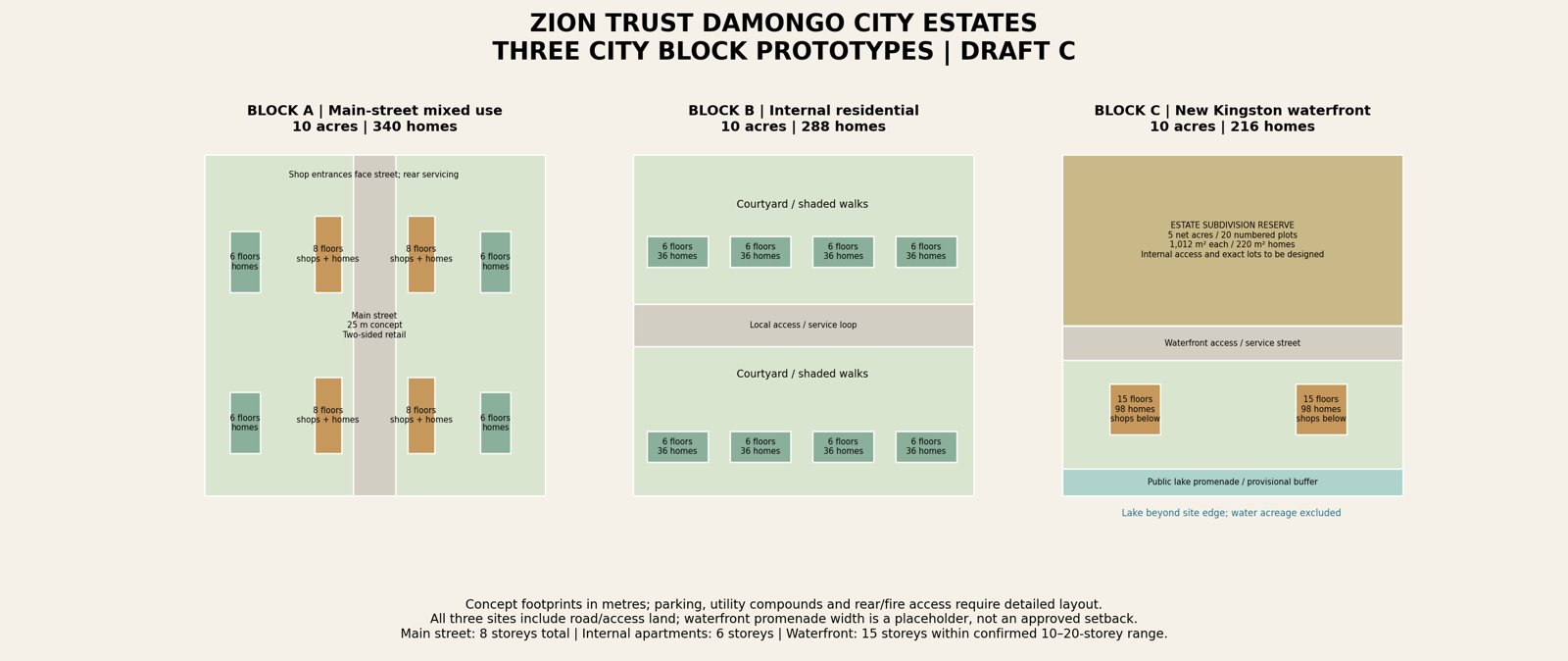
Indicative ten-acre block capacities: 340 homes for mixed use, 288 for internal residential, 216 for waterfront. Concept costs: USD $106.5–138.5 million, $85.8–111.6 million and $101.6–136.2 million respectively, including allowances for local services, fees and contingency. Land, tax, finance, lake works and bulk city infrastructure are excluded.
Illustrative full development: 136,224 homes and about 490,000 residents, requiring phased delivery and revised zoning. New Kingston central mall concept: 80,000 m² lettable retail in 100,000 m² building floor area on a 40-acre site, expandable from a 20,000 m² lettable first phase. This serves community demand; it is not designed for all residents to attend at once.
View the full block layouts, costs, service plan and shopping center concept
Explore the revised 25-borough graph with country and community labels, proposed historical and cultural street names, 35 invitation drafts and a researched institutional outreach register. New Kingston retains the five central heritage themes.
View country graph & all heritage street mapsPublic announcement & press releaseCountry invitations & outreach listProposed naming for consultation. No foreign-government or community endorsement is implied. Existing land-use reservations and plot IDs remain controlling.
Borough naming now follows the regional ville convention throughout. New Kingston remains the shared central lake district name; the five underlying cultural borough references retain their ville names.
New Kingston is the city's proposed central waterfront destination: a man-made lake, public park and water reserve, waterfront homes, entertainment attractions and shopping center. Lake depth, water source, flood management, dam requirements and waterfront setbacks require feasibility studies; this is not a construction plan.
The city concept now carries 25 cultural borough themes and 250 internal street naming entries, including 50 deferred by the new lake district. Downtown and uptown reference streets are prioritized, including Toronto's Yonge Street and Eglinton Avenue East/West, New York's First and Second Streets/Avenues and Flatbush Avenue, and Bridgetown's Broad Street and Swan Street. Heritage and community names supplement the reference streets where needed.

New Kingston occupies five central borough areas (B08, B12, B13, B14 and B18): 2,000 gross acres comprising a proposed 600-acre man-made lake across B13/B14, 800 acres of surrounding park, 400 acres for waterfront properties, entertainment, shopping and civic uses, and 200 acres for access and utilities. These are draft program allocations, with waterfront plots still to be designed. The other 20 boroughs each retain 36 ten-acre planning blocks, giving 720 blocks citywide. Fifty former internal streets in the central district are deferred naming references; 200 streets remain plotted. Borough themes include countries, cities, territories and Indigenous communities; they are not 25 sovereign countries. The named communities welcome all residents and imply no official affiliation or endorsement.
Marcus Garvey Boulevard; Nanny of the Maroons Avenue; Samuel Sharpe Road; Paul Bogle Street; George William Gordon Drive; Bob Marley Way are proposed for the B01 heritage corridors. Earlier place-name references are superseded for these proposed major corridors; final street registration follows the adopted layout.
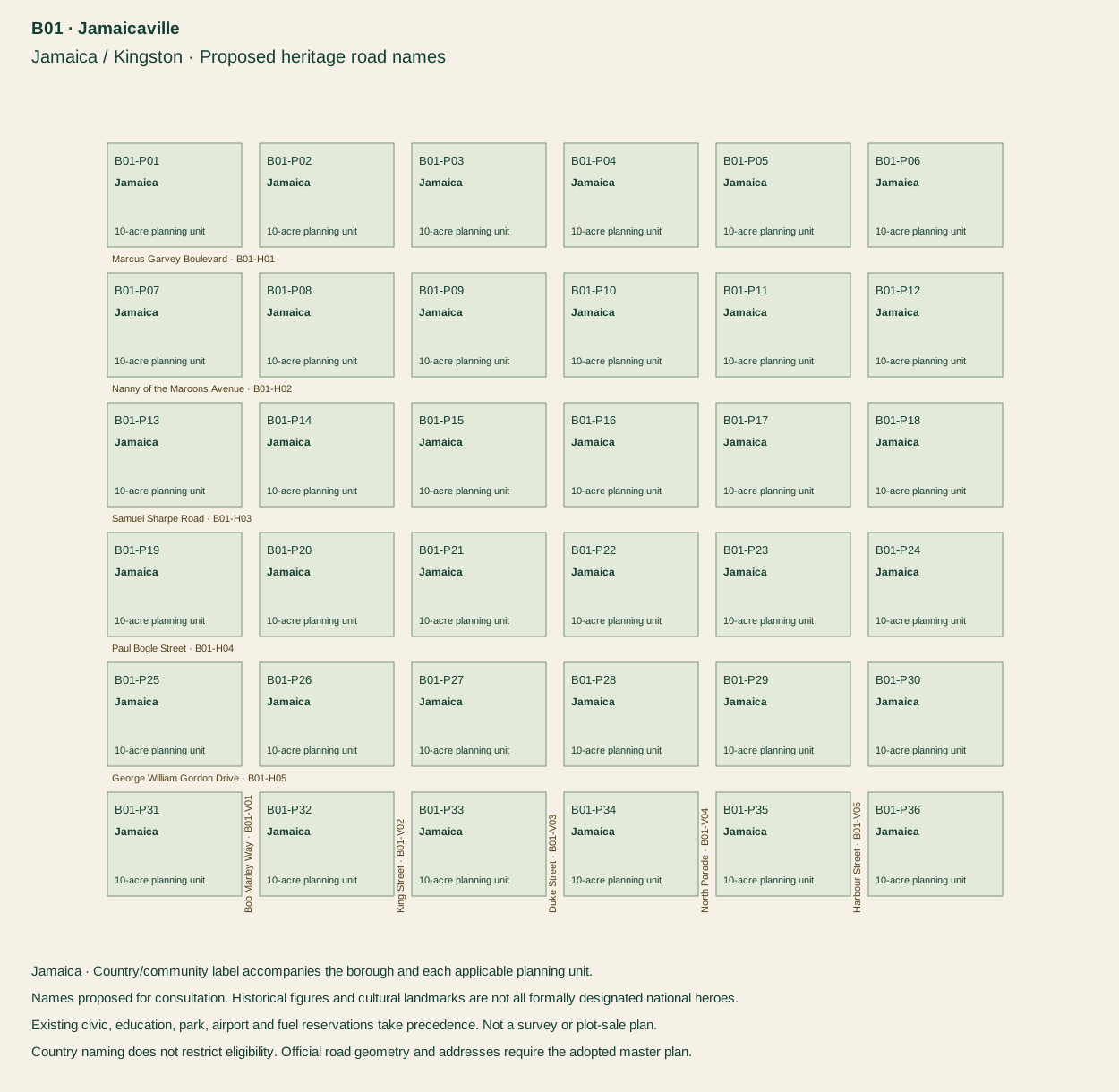
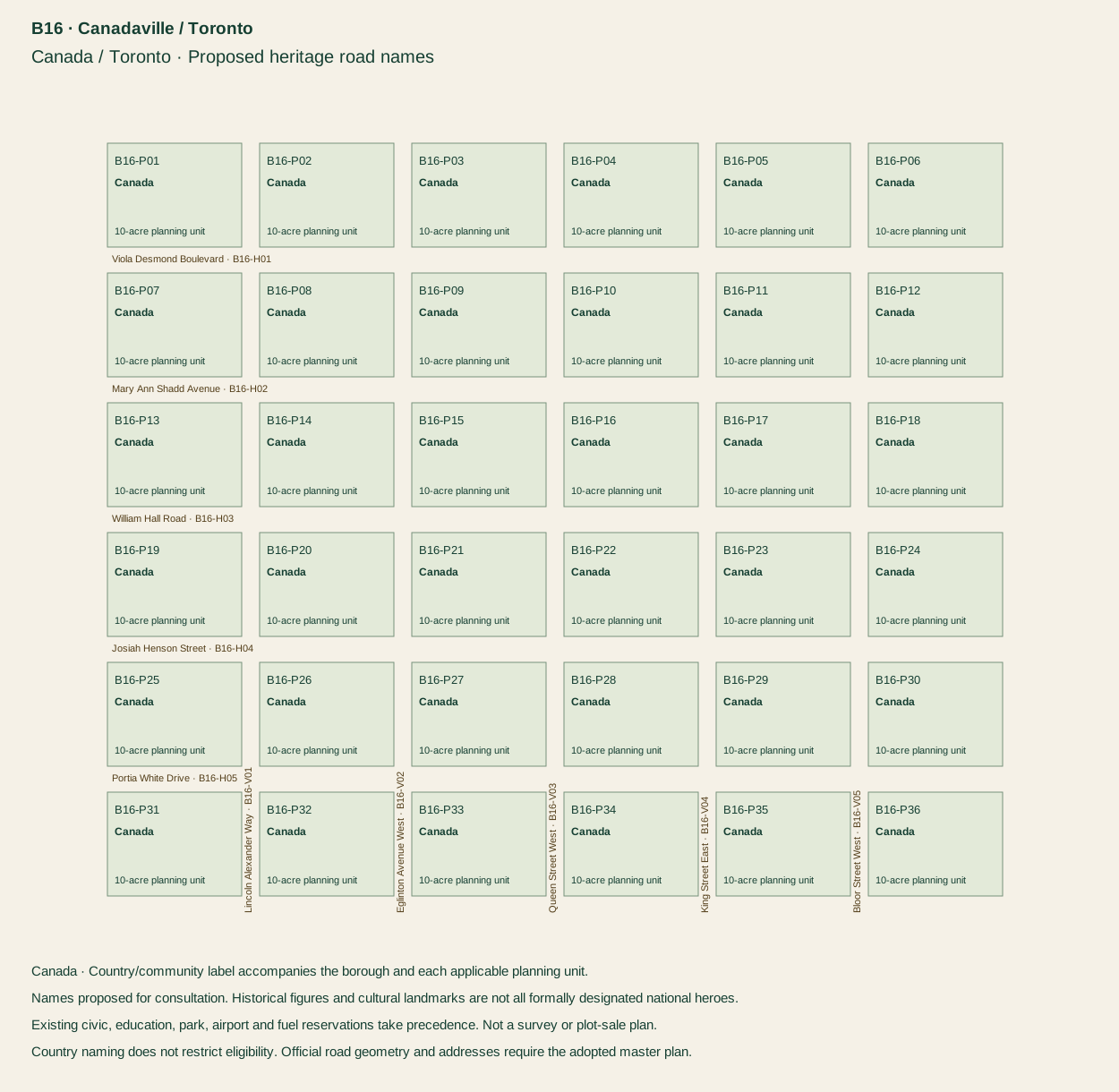
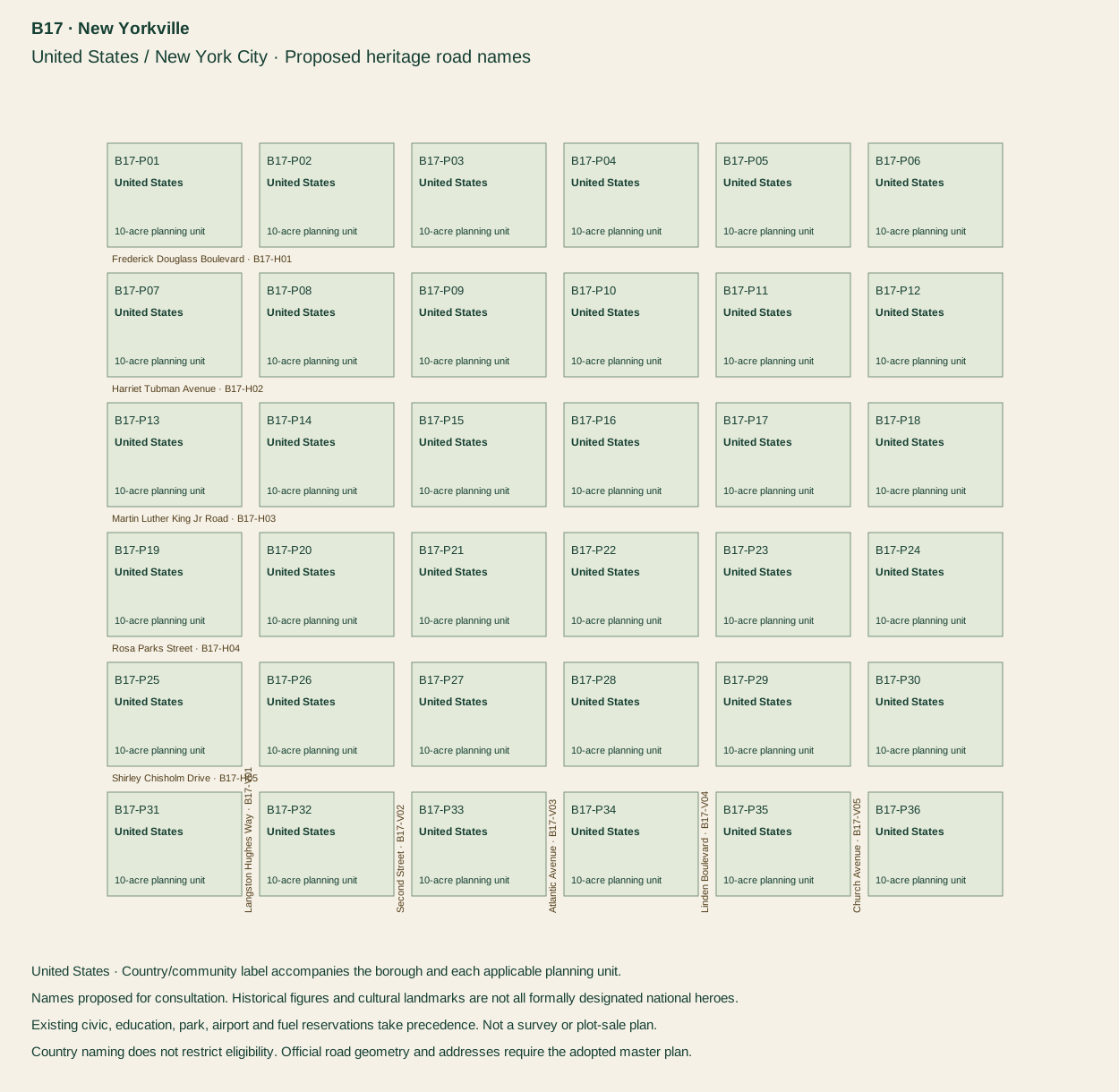
The Greater Caribbean borough includes island/territory avenues; additional Caribbean plaza names remain proposed for later mapping. First Nations and Native American borough names are tentative pending consultation with Six Nations of the Grand River, Navajo Nation and Cherokee Nation. No naming consent or partnership is represented. First Nationville — Canada and First Nationville — U.S. are cultural borough names only and do not establish legal reserve status.
Reference names are adapted to the Damongo grid rather than copied city geometry. Borough-qualified addresses and unique street IDs distinguish repeated names. This is a naming and planning draft, not surveyed residential allocations or a construction plan.
Within the overall seven-mile-by-seven-mile, 31,360-acre estate, this original draft adapts selected Kingston and Saint Andrew street names to a straightened road schematic. It is not a traced or exact duplicate of the Jamaican street map.
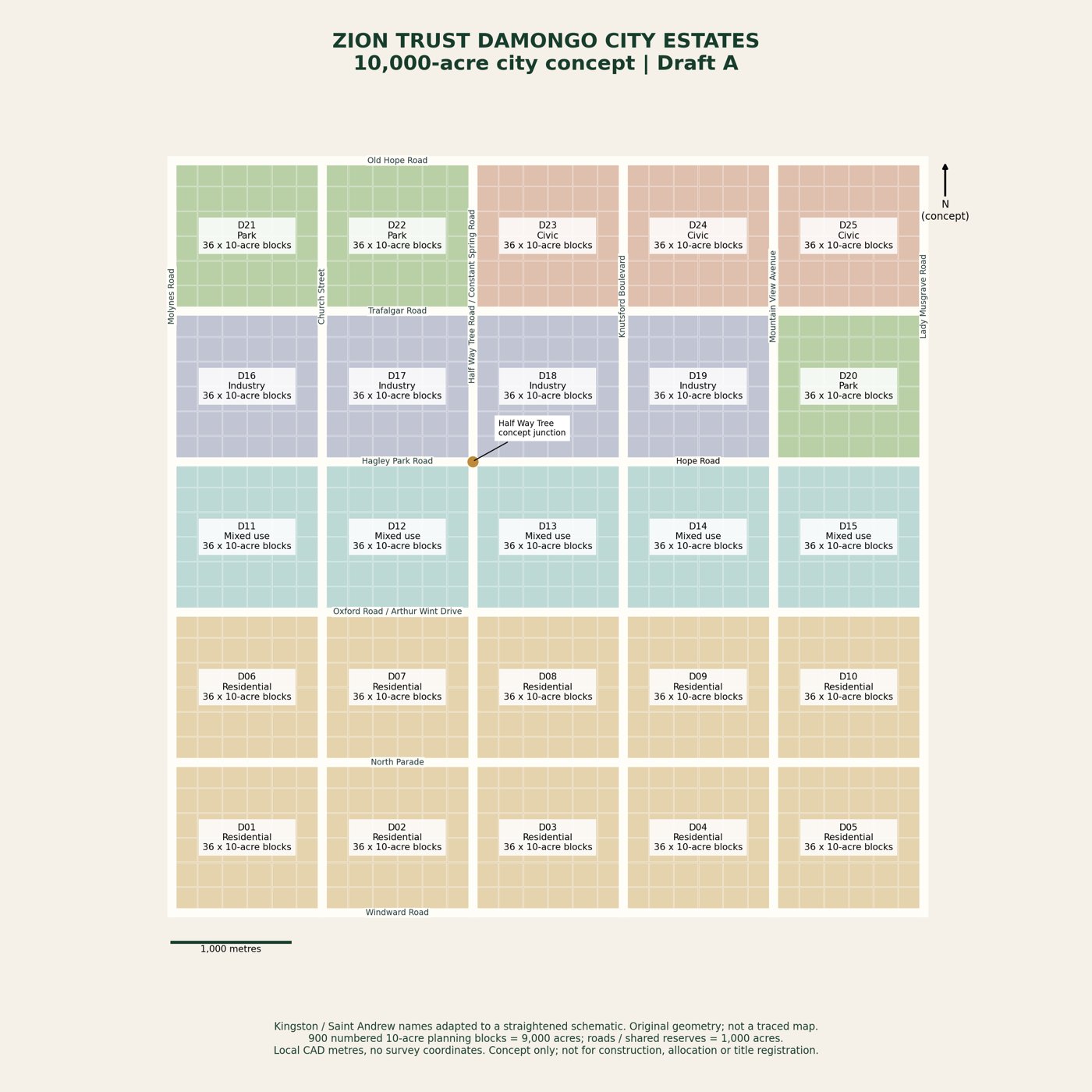
25 districts of 400 gross acres contain 900 numbered 10-acre planning blocks, totalling 9,000 acres. A further 1,000 acres covers roads and shared reserves. The remaining 21,360 acres of the estate is outside this city concept. Draft districts include residential, mixed-use, industry, civic and park uses; not all planning blocks are offered residential plots.
AutoCAD-compatible DXF uses metres and a local origin, with no surveyed geographic coordinates. Actual residential plot locations and approved land allocations remain forthcoming. Boundaries, terrain, drainage, road engineering, utilities and planning approvals must precede a construction or registration plan.
Reference street names and the Half Way Tree junction motif were checked against the National Library of Jamaica and Kingston route maps.
Follow the Damongo development project posts and community updates.
Damongo development on FacebookThe One Person, One Acre contract-farming program is designated as the premier proposed project within the Damongo City development plan. It invites cooperating community growers, contract offtakers, processors and prospective financing partners to help develop seasonal production and long-term orchards.
Contract offtakers are invited to specify crops, quantities, quality standards, harvest windows, delivery points and proposed pricing. Public participation through investment tokens is a proposed financing route: token value, underlying rights, use of proceeds, asset backing, eligibility, transfers, redemption and investor disclosures must be established in project-specific documentation and applicable approvals before an offering or funds collection. This page accepts inquiries through the existing proposal channels; it does not sell tokens or promise returns.
Register grower / offtaker interestRequest investment informationProposed token protection termsEffective 12 October 2026. Estate acreage reference: 31,360 acres. Actual deed registration identifiers and surveyed boundaries are recorded from the executed land documents.
Newly planted or cultivated resources, and entities developed within the Savannah concession region, contribute 10% of positive net proceeds to the designated Royal Trust. 90% remains with operations and private participants under their signed agreement.
Existing naturally inherited bearing resources are managed under a product-specific public–private partnership (PPP) schedule. For existing bearing-tree shea-nut and shea-butter production sourced ONLY from the allocated Zion Trust Estates acreage: 30% to the Gonja Kingdom and Royal Chiefs’ Council; 40% to Earthman Herbals operations managers; 30% to the Royal Savannah Diaspora Development Committee Trust Fund. Earthman Herbals manages the combined 70% operating allocation.
This specific shea schedule replaces the general 10% contribution for the same product proceeds; do not deduct both. New shea cultivation retains the general 10% / 90% schedule. Specialty timber, minerals and other inherited products require their own agreements and do not automatically adopt the shea percentages.
Net proceeds means verified realized product receipts less documented, agreed production and operating costs, before these allocations. These are mandatory contractual community contributions, not labeled statutory taxes. Each agreement identifies the product, resource origin, eligible costs, reporting period and authorized recipients.
Separate ledgers track existing-bearing and newly-cultivated resources, harvest batches, raw nuts directed to sale or butter processing, costs and recipient contributions. Do not count the same nuts as both raw-product sales and butter-production inputs. Preserve culturally retained trees and documented community rights. Individual participants collaborate under a named organization, family or trust; development units record funded participation separately from registered land rights.
Contracted buyers may receive a price reduction of up to 30% from the agreed farm-price benchmark, as specified in each offtake agreement. The project’s instructed 40% retention envelope is now split into 10 percentage points for the sponsor yield pool and 30 percentage points for internal crop development, supporting new acreage and permanent fruit crops.
The 30% buyer reduction is a price discount; the three 10% allocations above are shares of crop yield. The 40% is the instructed retention envelope; the sponsor pool is carved out of that envelope, rather than added to it. They require a common valuation and cost reconciliation before a realized margin can be calculated; subtracting these percentages alone does not establish a 40% cash profit. The agreements must identify the farm-price benchmark and a consistent yield valuation and retention basis. The earlier 40% internal-development-only target is superseded by this 10% / 30% split.
| Year | New acreage | Cumulative established acreage |
|---|---|---|
| 1 | 100 acres | 100 acres |
| 2 | 100 acres | 200 acres |
| 3 | 100 acres | 300 acres |
Cumulative acreage includes earlier plots; seasonal intercrops do not create additional land. This illustrates annual acreage expansion, not a guaranteed compound growth rate or an assumption that new orchards bear fruit immediately. Plowing one acre at a time describes the plot sequence; the current cost projection assumes the plow completes four acres per machine-day.
Apply to join the Damongo land-interest network. Tell us where you are from and what you seek: agricultural land use, a long-term lease, acquisition/ownership consideration, or future residential development. Submission is an inquiry for assessment, not a land grant, title transfer, paid membership or investment acceptance.
Residential plots and development locations are forthcoming. Their details will be added when provided by the project team; applicants may register interest now.
Application review: Royal Savannah and Diaspora Community Development Trust · Zion Trust Estate management and development committee.
Join the network · membership informationIndividuals may participate in blocks of 10 acres or more, including African diaspora relatives, families and investors seeking a personal landholding, possession and long-term use arrangement under the documented stool-land grant. Eligible blocks may be structured through long-term lease and/or residential agreements, according to the approved land-use plan.
Private possession and any ownership rights expressly granted may be retained by the individual participant for the agreement’s term, subject to the landholder’s authority, the final land instrument and its conditions. An investment or token purchase alone does not confer freehold ownership or establish a land claim. Leasehold rights, residential rights, ownership of improvements and underlying land title must be distinguished in the agreement.
Each block agreement must identify surveyed boundaries, grantor and authorized signatories, tenure and duration, permitted agricultural/residential uses, possession, improvements, transfer or inheritance provisions, renewal and termination, payments and registration requirements. Residential use requires a designated and approved residential allocation; cultivated acreage must not be counted again as a separate residential grant.
Individuals taking 10 acres or more use the US$500 block-participation membership category, with land agreement charges and project funding separately documented. This does not extend the US$100 under-10-acre agricultural membership to residential rights. The 31,360-acre gross planning figure does not establish that any specific block has already been granted.
Submit individual / family / diaspora block interestIndividuals, groups and corporations may choose payment in full or a 40% initial deposit followed by 12 monthly instalments for the remaining 60% of their approved investment commitment. The deposit and instalments are credited toward that commitment. Membership is separate and payable at joining.
The monthly plan supports ongoing crop maintenance and operating costs. The participation contract will specify the approved total, due dates, first monthly payment date, final rounding adjustment and consequences of missed payments. Choosing this preference does not charge a card or activate recurring billing.
Return calculations use actual funded capital and funding dates; unfunded future instalments do not earn a full-year return. The investor payment plan is separate from the buyer’s offtake schedule, which still requires cumulative 80% before FOB delivery. Six-month token maturity does not cancel the 12-month payment commitment. The investment deposit is also separate from the $500-per-acre mobilization budget line, which forms part of the total commitment.
Submit participation and payment-plan preferenceThe One Person, One Acre program and other approved contract-farming portfolios may reconcile the first six-month vegetable crop settlement against the participant’s remaining investment payments, or reinvest it in the participant’s account. Month six is a review checkpoint: credits are posted only after actual harvest sales are collected and the crop account is settled. It is not a guaranteed six-month payout.
Settlement basis: Record collected sales, crop costs, prior advances, applicable taxes, agreed council and operating allocations, reserves and the participant’s entitlement under the signed agreement. Only the participant’s verified net amount available for distribution can be credited. Gross crop sales, unrealized valuations, target returns and promised offtake payments are not available credits. Costs and advances must be reconciled once, without double counting.
| Participant election | Use of verified earnings |
|---|---|
| Reduce remaining monthly payments | Apply up to the unpaid commitment, then spread the remaining cash balance over the remaining scheduled months. Issue an amended schedule. |
| Cover upcoming payments | Pay the next installments from the earnings credit until exhausted. If the credit covers the entire unpaid commitment, the participant’s remaining cash contributions become zero. A partial credit leaves the difference payable. |
| Reinvest / compound | Allocate the earnings to an approved next crop or investment cohort, recording the funded capital, date, acreage and token/unit issue terms. Existing installment obligations continue unless a separate authorized amount is credited toward them. |
| Split allocation | Permit a signed instruction dividing earnings between payment credits, reinvestment and any contract-permitted withdrawal. Total allocations cannot exceed the available settlement. |
Any earnings remaining after the commitment is paid follow the participant’s documented reinvestment or permitted withdrawal instruction. No automatic extension of maturity or token redemption terms is assumed. A participant may change the election prospectively before the relevant settlement is posted; posted entries require a documented correction.
Approved commitment: US$7,000; initial 40% deposit: US$2,800; 12 payments of US$350. After six monthly payments, contributions total US$4,900 and US$2,100 remains. Assume, solely to illustrate reconciliation, a US$900 verified participant earnings settlement:
| Election | Result |
|---|---|
| Spread credit over six remaining months | US$2,100 − US$900 = US$1,200 remaining cash; six payments of US$200. |
| Cover next payments | Credit covers US$350 in month 7, US$350 in month 8 and US$200 of month 9. Cash due: zero, zero, US$150, then US$350 in each of months 10–12. |
| Reinvest all earnings | Credit US$900 as newly funded capital in the approved next cohort. Remaining six US$350 installments continue. A gross contribution ledger would total US$5,800 at that point before any capital redemption, losses or other adjustments; this is not an asset valuation. |
A verified US$2,100 credit in this example could cover all remaining payments. If crop earnings are lower, late or absent, unpaid installments continue under the agreed contract unless formally rescheduled. The 20% annual performance target does not establish the settlement amount; calculation uses actual eligible funded capital and funding dates, not the full unfunded commitment.
Upon reconciliation of the first applicable crop period, expected to be reviewed at six months, the Company shall issue a participant statement showing collected revenues, approved costs and allocations, the participant’s distributable entitlement, and any outstanding investment commitment. Pursuant to the participant’s recorded election and signed agreement, verified distributable earnings may be applied to reduce or satisfy future installments, allocated to an approved reinvestment cohort, or split between these purposes. The same funds shall not be counted as both an installment payment and a separate reinvestment. No credit shall arise solely from a projected yield, return target or uncollected sale. The Company shall record each credit and issue the revised payment schedule or reinvestment confirmation.
Internal record: participant ID, plot/acre and crop-cohort ID, harvest and receipt references, currency, collected sales, cost/advance reconciliation, agreed entitlement, election, settlement date, installment credits, reinvested amount, any withdrawal, remaining commitment and approving officer. Preserve a statement and an audit reference for every posting. Returned capital must be identified separately from earnings. This rule applies to agricultural investment accounts; residential plot fees and the buyer’s FOB offtake milestones remain separate.
Operating direction: Agricultural working capital is intended for productive redeployment, rather than accumulation as idle company funds. As each suitable seasonal crop is harvested and sold, reconciled working funds are recycled into seeds or seedlings, crop inputs, labour and approved land preparation for the next planting cycle. The planning rhythm is approximately six months for the relevant vegetable/seasonal crop cohorts; actual planting and harvest dates follow each crop’s requirements.
Successive cycles aim to sustain production and fund approved expansion. Additional acreage is brought into production in the agreed one-acre-at-a-time sequence; expansion depends on collected receipts, available inputs, workforce, water, land rights and buyer demand. Fruit-tree establishment and other longer-cycle assets are accounted for separately and are not assumed to yield every six months.
Collect crop-sale receipts → reconcile costs, advances, council/contract allocations, taxes and participant entitlements → post authorized installment credits or reinvestment instructions → identify sums due for settlement and the next-cycle operating reserve → redeploy available working capital into procurement and planting → record the next cohort and acreage. New-cycle cash funding cannot include money already spent, paid out or counted as another funding source.
Participant protection: Recycling does not cancel a distribution, capital repayment, token maturity or redemption obligation. Amounts due are settled or supported by an agreed funded reserve; renewed participation or rollover follows the signed terms and required participant authorization. An earnings credit against installments is an account allocation, not a second cash receipt. The same cash may support operations after an authorized credit, but it cannot be counted twice as installment funding and additional reinvestment.
| Account / asset | Evidence and record |
|---|---|
| Cash and working-capital recycling | Bank receipts, payment references, crop/cohort source, permitted use, procurement payments and unspent balance. Reconcile bank cash to the ledger. |
| Seeds, inputs and growing crops | Purchase invoices, stock movements, crop type, acreage, planting date, quantity issued, harvest quantities and realized sales. Distinguish physical inventory from expected future revenue. |
| Equipment and infrastructure | Asset ID, owner, purchase or lease terms, cost, location, condition, use records and maintenance. A leased asset is not described as owned equipment. |
| Land-use and acquisition rights | Plot/parcel ID, mapped boundary, grantor and authority, sealed instrument, registered interest where applicable, term, permitted use, acquisition payments, commitments and encumbrances. Leasehold rights are distinguished from freehold ownership. |
| Participant investment account | External contributions, funding dates, earned entitlement, installment offsets, approved reinvestment, withdrawals, returned capital, unpaid commitment and maturity/redemption obligations. |
| New acreage and development commitments | Approved allocation, costed preparation plan, procurement authority, funding source and release milestone. Record committed costs before reporting surplus available for expansion. |
Issue a cycle-end reconciliation and participant statement. Showing cash converted into seeds, crops or equipment is an explanation of use, not proof of increased asset value or guaranteed returns. Record losses, crop failures and liabilities as well as production gains.
Participants and development partners may request agricultural acres, residential plots or five-acre, ten-acre and larger allocations through the relevant application channel. Agricultural investment participation does not itself convey ownership of land. Each acquisition or lease development is tied to its own documented parcel rights, approvals, budget and agreement; acreage is released according to confirmed availability.
Request a plot or larger allocationSubmit a development or investment partnershipRoyal heritage and project-reported land documentation
Individual membership: US$100 for individuals participating in fewer than 10 acres, with access limited to Savannah agricultural development and the One Person, One Acre / one-plant portfolios. Group and corporate membership: US$500, including organizations and group-block participation. Ten-acre and larger commitments use the group/corporate category.
Membership is separate from US$500 mobilization per acre and the per-acre maintenance funding commitment. Membership alone does not fund acreage, issue tokens or provide confidential project files. Full documentation and project-specific acceptance are required.
| Component | Basis | Amount |
|---|---|---|
| Labour maintenance | $20/day × 5 days/week × 52 weeks | $5,200 |
| Fertilizers, materials and service allowance | $25–$50/week × 52 weeks | $1,300–$2,600 |
| Maintenance subtotal | Labour plus materials | $6,500–$7,800 |
| Initial acreage mobilization | $500/acre | $500 |
| Total per-acre commitment | Mobilization plus maintenance, before membership | $7,000–$8,300 |
| One-acre individual including membership | One $100 membership plus one acre | $7,100–$8,400 |
| 10-acre group including membership | One $500 group membership plus 10 acres | $70,500–$83,500 |
For N acres, budget = category membership fee + N × ($500 mobilization + $6,500–$7,800 maintenance). Membership is charged once per joining individual or group, not per acre. This replaces the earlier 10-person-day establishment illustration as the ongoing maintenance basis; establishment labour must not be added again without an explicit separate scope.
The $500 per-acre investor mobilization allocation is distinct from the buyer’s minimum 40% mobilization deposit on an offtake contract. Funding reconciliation must prevent both sources from being counted twice for the same cost. The 12-month maintenance commitment is also distinct from the six-month crop-token maturity; redemption does not automatically cancel an outstanding maintenance obligation.
These are instructed funding allowances, not proof of complete project costs. Final crop-specific budgets must reconcile actual initial planting costs, clearing and equipment, water, transport, processing and other unpriced services. Payment dates and maintenance obligations will be documented in the participation contract.
A proposed return-bearing community investment program connects a sponsor, a community participant and one assessed production acre. Sponsorship supports agricultural employment, production and community development through documented investment participation.
| Item | Calculation | Amount |
|---|---|---|
| Plowing | One acre ÷ four acres/day × $200/day | $50 |
| Labour illustration | 10 person-days × $20/day | $200 |
| Plowing and labour subtotal | Before planting allowance | $250 |
| Excavator / clearing | Allocated machine-days × $200/day | Assessment required |
| Fruit-tree-inclusive planting allowance | Preliminary $250–$500 per acre | $250–$500 |
The $250 subtotal is an establishment-cost illustration. The current sponsorship framework above instead provides $500 mobilization per acre plus a 12-month maintenance commitment and category membership; this partial subtotal is not the participation price. Including the preliminary $250–$500 fruit-tree planting allowance gives $500–$750 per acre in listed direct costs. At 100 acres, the listed direct estimate is $50,000–$75,000, before clearing and other unpriced project costs. Ten person-days per acre does not define the participant’s annual employment pay.
The proposed portfolio links approved funding to identified plots or production cohorts, with records of the sponsor, participant, acreage, crop plan, funding uses, eligible tokens, harvest quantities and settlement accounts. The sponsor distribution pool is 10% of agricultural yield, taken from the existing 40% retention envelope, leaving 30% for internal crop development.
After the contractually agreed harvest valuation and reconciliation, each eligible token holder receives a proportional share of the available sponsor pool: holder distribution = available sponsor pool × holder eligible tokens ÷ total eligible tokens in that pool. The 10% defines the pool allocation, not a fixed 10% return on sponsored capital. Actual distributions depend on realized production and the agreed settlement basis.
Agriculture investment tokens are proposed to be transferable and redeemable after maturity, with a six-month maturity for each contracted crop cohort. Transfer procedures, redemption requests, valuation, settlement funding, repayment of capital and token issue price will be specified in the portfolio agreements. Six-month token maturity does not imply that fruit trees produce a commercial harvest within six months; each cohort must identify its crop cycle and the source of redemption funds. Sponsoring an acre does not itself transfer stool-land ownership or establish an unconditional right to cash out.
This is a proposed portfolio structure for documentation and required approvals before token issuance or funds collection. No investment checkout is activated on this page.
Request community portfolio informationRegister community participant / sponsor interestThe individual single-acre proposal now targets 20% per annum on eligible invested capital, with crop-by-crop reconciliation of revenues generated by that acre. This is a proposed performance target, not a guaranteed payment or an established operating result. Membership fees are excluded from invested capital; eligible funded mobilization and maintenance capital, funding dates and any withdrawals must be recorded in the participation contract.
For each crop on each acre, record actual saleable harvest × realized sale price, then reconcile costs, contractual allocations and available distributable funds. The existing 10% sponsor-yield pool and 30% development retention remain recorded; a 20% capital-return target does not itself increase that pool. Any funding shortfall or proposed change to the pool requires a documented reconciliation rather than an assumed payment.
| Eligible investment per acre | 20% annual target | Capital plus target return |
|---|---|---|
| $7,000 | $1,400 | $8,400 |
| $8,300 | $1,660 | $9,960 |
These examples use the current $500 mobilization plus $6,500–$7,800 annual maintenance envelope, excluding membership, and assume the entire amount is eligible and invested for a full year. Instalments funded later require time-weighted calculations; the figures are not current token prices or promised redemption values.
For an effective annual target of 20%, the equivalent six-month rate is √1.20 − 1 = 9.5445%. If two six-month returns are achieved and reinvested, capital × 1.095445 × 1.095445 = capital × 1.20. A simple non-compounding six-month allocation is 10% of capital; reinvesting two 10% returns would produce 21% for the year, rather than 20%.
Illustration for $7,000 with two successful reinvested six-month periods: first target return $668.12; reinvested balance $7,668.12; second target return $731.88; year-end balance $8,400. Crop-period attribution must follow actual harvest timing and that acre’s realized revenues; two commercial harvests per year are not assumed for every crop.
Multi-year illustration: closing capital = opening eligible capital × 1.20^years, only where each annual target is achieved and returns are reinvested. Withdrawn distributions do not compound. New contributions and withdrawals must be accounted for separately. The definitive agreement must specify whether returns are paid out or reinvested and how crop revenues support each distribution.
A proposed 1,000-acre industrial hemp production allocation is included within the assessed Damongo agricultural land plan, not added to the 31,360-acre gross development area. Individual participation is structured by one acre; organizations and groups may participate in 10-acre blocks. Mixed participation must total no more than the approved 1,000 acres.
| Scale | Plowing at four acres/day | Illustrative labour at 10 person-days/acre | Listed subtotal |
|---|---|---|---|
| 1 acre | $50 | $200 | $250 |
| 10-acre group block | $500 | $2,000 | $2,500 |
| 1,000-acre portfolio | $50,000 | $200,000 | $250,000 |
These are preparation and illustrative labour costs, not complete investment prices. Hemp seed, clearing, irrigation, crop care, testing, harvest, drying, transport, processing and working capital require separate quotes. The fruit-tree and vegetable-seed allowances do not price hemp planting. Labour must be reassessed for the chosen fibre, grain or dual-purpose system.
| Stream | Proposed processing | Potential products |
|---|---|---|
| Stalk and bast fibre | Harvest, retting, decortication, cleaning and grading | Textile inputs, paper and packaging fibres, insulation and fibre composites |
| Hurd / woody core | Separation, drying and size grading | Hemp-lime construction infill, panels, bedding and composite inputs |
| Grain / oilseed | Cleaning, drying, dehulling and pressing | Hemp seed oil, seed ingredients and press-cake/protein products, subject to product approvals |
| Processing residues | Recovery and suitability assessment | Biochar, biomass and other approved industrial co-products |
Separate cultivation and processing budgets will track seed and inputs, acreage, harvest quantities, saleable recovery rates, plant throughput, equipment and buildings, utilities, staffing and signed offtake specifications. Revenue equals saleable product quantity × agreed buyer price; avoid counting raw stalk or seed sales again where those materials are consumed in processing. No production yields, equipment prices or returns are assumed without supporting quotes and trials.
Licensing: Ghana’s regulated program covers cannabis with no more than 0.3% THC under relevant licences. Cultivation, processing and other applicable permissions, crop testing and suitable varieties must be established before operations. No project licence is represented as secured here. NACOC requirements.
Industrial references: USDA hemp applications and materials and co-products research.
The hemp portfolio will maintain separate participant allocations, cultivation and processing accounts, offtake agreements and distribution reconciliations. Existing crop-token terms are proposed only where expressly incorporated into that cohort’s documentation; a processing-facility investment requires its own term and repayment plan.
Individual and group investment frameworkSubmit hemp production / offtake interestPlanning estimates supplied by Global Exchange, in USD per acre. These are budget allowances to be reconciled with crop-specific quantities and supplier quotes.
| Planting option | Planting allowance / acre | Including $50 plowing + $200 illustrative labour |
|---|---|---|
| Vegetable garden seeds | $5–$20 (including a $10 middle estimate) | $255–$270 |
| Coconut planting allowance | $200 | $450 |
| Fruit-tree-inclusive planting | $250–$500 | $500–$750 |
At $5–$10 per fruit seedling, a $250 allowance purchases 25–50 seedlings and a $500 allowance purchases 50–100 seedlings. A $200 coconut allowance purchases 20–40 seedlings if the same $5–$10 unit price applies. These are purchasing quantities, not recommended planting densities; spacing and species determine actual seedlings per acre.
For a 100-acre phase, fruit-tree-inclusive planting allowances total $25,000–$50,000; adding $5,000 plowing and $20,000 illustrative labour gives $50,000–$75,000 in the listed direct costs. Clearing/excavator days, irrigation and other unpriced costs remain additional. Separate seed and seedling allowances should only be combined where both are required; do not count the same materials twice.
The calculator below accepts these assumptions through planting units and unit prices. For example, 50 seedlings at $5 gives $250 per acre; 50 seedlings at $10 gives $500 per acre. Mixed crop rows need crop-specific quantities before procurement. These estimates do not establish token issue prices or guaranteed returns.
Each initial contract-farming/offtake agreement will include a dated production and payment schedule covering commencement, crop establishment, production milestones, harvest and the delivery window.
| Stage | Payment requirement |
|---|---|
| Mobilization deposit | Minimum 40% of contracted value at commencement under the agreed schedule, credited toward the total contracted value. |
| Scheduled payments before delivery | Milestone instalments bringing cumulative payments to 80% before delivery, inclusive of the down payment. |
| Upon delivery | Remaining balance due upon delivery; 20% where cumulative pre-delivery payments equal 80%. |
Draft contract term: The Buyer shall pay a mobilization deposit of at least forty percent (40%) of the agreed Contract Value at commencement under the contract schedule. The mobilization deposit funds land preparation, clearing, plowing, the initial purchase of seeds or seedlings, and mobilization of the human resources needed to commence and execute development under the contract. This deposit shall be credited toward the Contract Value and included in the cumulative eighty percent (80%) payable before delivery; it is not an additional fee. Further instalments shall be paid on the dates and production milestones stated in the contract schedule, bringing total payments to eighty percent (80%) of the Contract Value prior to delivery. The outstanding balance shall be payable upon delivery against the delivery evidence specified in the agreement.
Delivery term: FOB — Free On Board, [named port of shipment serving the production location], Incoterms® 2020. For the FOB shipment, delivery occurs when the goods are loaded on board the vessel nominated by the Buyer at that named port. The final payment is due at that delivery event against the agreed on-board shipment documentation. The port, shipment window, vessel nomination and documentary requirements must be completed in each contract.
ICC reference: FOB delivery. These are recorded draft contract terms for incorporation into the definitive farming/offtake agreement.
Maize and corn are the same crop and are counted once. The proposed seasonal mix includes maize, cassava, pumpkins, peppers and locally selected vegetables, with legumes such as cowpea, groundnut and soybean assessed for rotation. Mango and cashew are priority orchard candidates for local assessment.
Seasonal crops may be assessed between young orchard rows where spacing, sunlight, water and root competition allow. Intercropping uses the same physical acreage: it must not be added again as new land. Pumpkin vines require space and management; planting within vines or orchard rows is subject to an agronomist’s layout.
Coconut, oil palm for oil and other byproducts, palms for wine, coffee and cocoa remain requested trial candidates. Suitable palm species and harvesting methods must be identified separately. They are not assumed suitable across Damongo’s savannah land. Local water, soil and climate tests must support any allocation; orchard cash flow must account for establishment and non-bearing years.
Evidence: Ghana MOFA identifies maize, cassava, vegetables, mango and cashew among northern-region crops, supporting their assessment as candidates rather than proof of this site’s suitability. FAO describes cocoa as a humid-region crop and oil palm as requiring high rainfall; COCOBOD and FAO also document coffee and coconut water requirements.
MOFA northern crop reference · FAO cocoa · FAO oil palm · COCOBOD coffee · FAO coconut
Zion Trust Damongo City Estates invites developers, investment partners, builders, corporations, banks, shopping-centre developers and operators, service providers and project facilitators to participate in any suitable part of the proposed development. Submit proposals to purchase plots or larger allocations, develop approved projects, finance infrastructure, form joint ventures, or operate facilities and services.
Join as a development partner · Submit a proposalBrowse numbered townhouse, standard and estate plots, street addresses and offer prices. Request a five-acre, ten-acre or larger allocation, or submit a preferred plot number with a US$100 initial application fee. Payment is through an approved private invoice; availability and full commitment documents are confirmed before reservation.
View plot plan and applyCore $500 preparation + $1,000 planting + $20 × three days/week × 52 weeks management. Enter additional quoted inputs beyond that baseline.
Zero extras mean no additional quotation has been entered, not that irrigation, fertilizer or extra services are free. Membership is separate. This model is first-year funding, not a crop-revenue forecast or recurring six-month charge.
This is an assessment scope and preliminary planning conclusion, not a completed feasibility study. The agricultural program is proposed as a phased component alongside the existing aviation, MRO, training and city infrastructure concept.
Phase 2 aviation development · Savannah Damongo MRO proposal and runway cost model
Project costs, yields, employment numbers and commencement dates remain to be established through that assessment and the definitive agreements.
Submit a community farming proposalEarthman community farming programInvestment portfolio